


If you are running a small business and trying to figure out how much to budget for a website, you are not alone.
Web designing cost in Singapore is one of the most common questions SME owners ask before going digital, and the range is genuinely wide.
A basic site can cost a few hundred dollars. A custom build can run into the tens of thousands. Knowing what drives that gap is what helps you spend well.
This guide gives you a straight breakdown of what to expect across design and development costs, recurring hosting expenses, and how to use government grants to soften the financial hit.
No fluff, no upselling. Just what you need to know before you sign anything.
What Web Designing Cost in Singapore Actually Looks Like
The numbers vary based on how complex your site is, what platform it runs on, and who builds it. Here is a realistic range by website type.
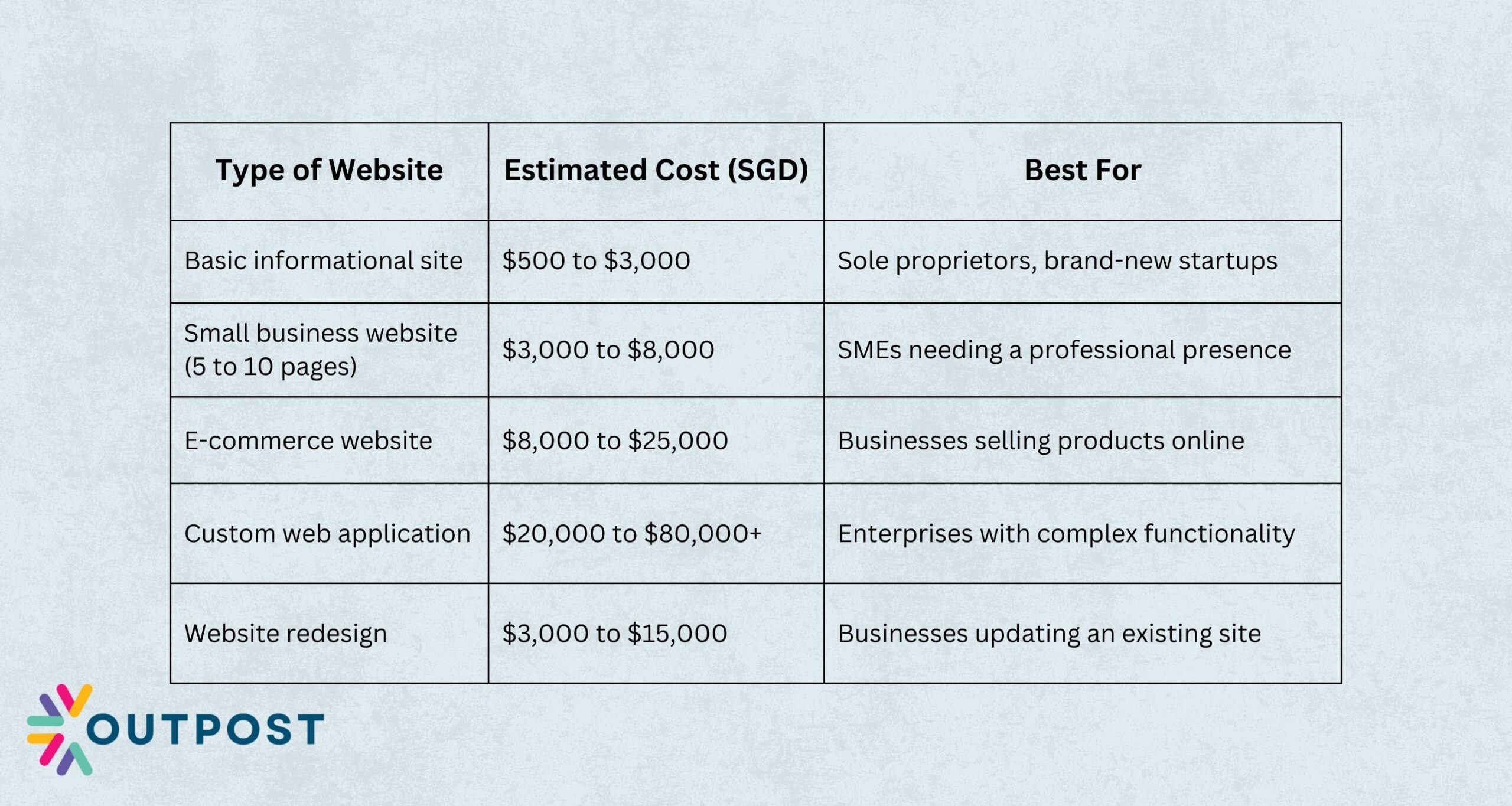
These numbers cover design and development only. The recurring costs of keeping a site live are a separate budget line, and we get into those shortly.
What Drives the Price of Web Design
Pricing web design comes down to a handful of factors that are worth understanding before you start collecting quotes.
Scope and Complexity
A five-page company profile and a thirty-page e-commerce platform are completely different builds.
Every additional page, custom feature, and third-party integration adds to the project scope and the final invoice.
The clearer your brief, the less likely you are to get hit with scope creep charges halfway through.
Platform
Most SMEs build on WordPress because it is flexible, widely supported, and manageable by non-technical teams after handover.
Other platforms like Shopify, Webflow, or a website builder like Squarespace bring different costs and trade-offs.
A website builder keeps the price low but limits what you can do with SEO and custom functionality down the line.
Template or Custom Design
A pre-built theme significantly reduces design hours because the foundational visual work is already done.
Full custom design, where every screen and element is built from scratch, takes far more time and costs accordingly.
For most SMEs, a well-customised template delivers strong results without the premium price of a fully bespoke build.
Content Creation
Most agency quotes cover design and development but not the actual words, images, or video on the site. A professional copywriter typically charges $80 to $200 per page.
Build this into your budget from the start.
Who Does the Work
A full-service agency brings a full team, structured project management, and clear accountability.
A freelancer often costs less and is a solid choice for straightforward builds, though bandwidth and specialist depth can be limiting factors on larger projects.
Some businesses find it more cost-effective to integrate dedicated digital talent directly into their operations.
Outpost is a virtual staffing agency that helps businesses build remote teams, including web and digital specialists who handle ongoing site management, content, and updates at lower overhead than local hires
For businesses with continuous digital work rather than one-off builds, this is worth looking into.
The Recurring Costs That Come After Launch
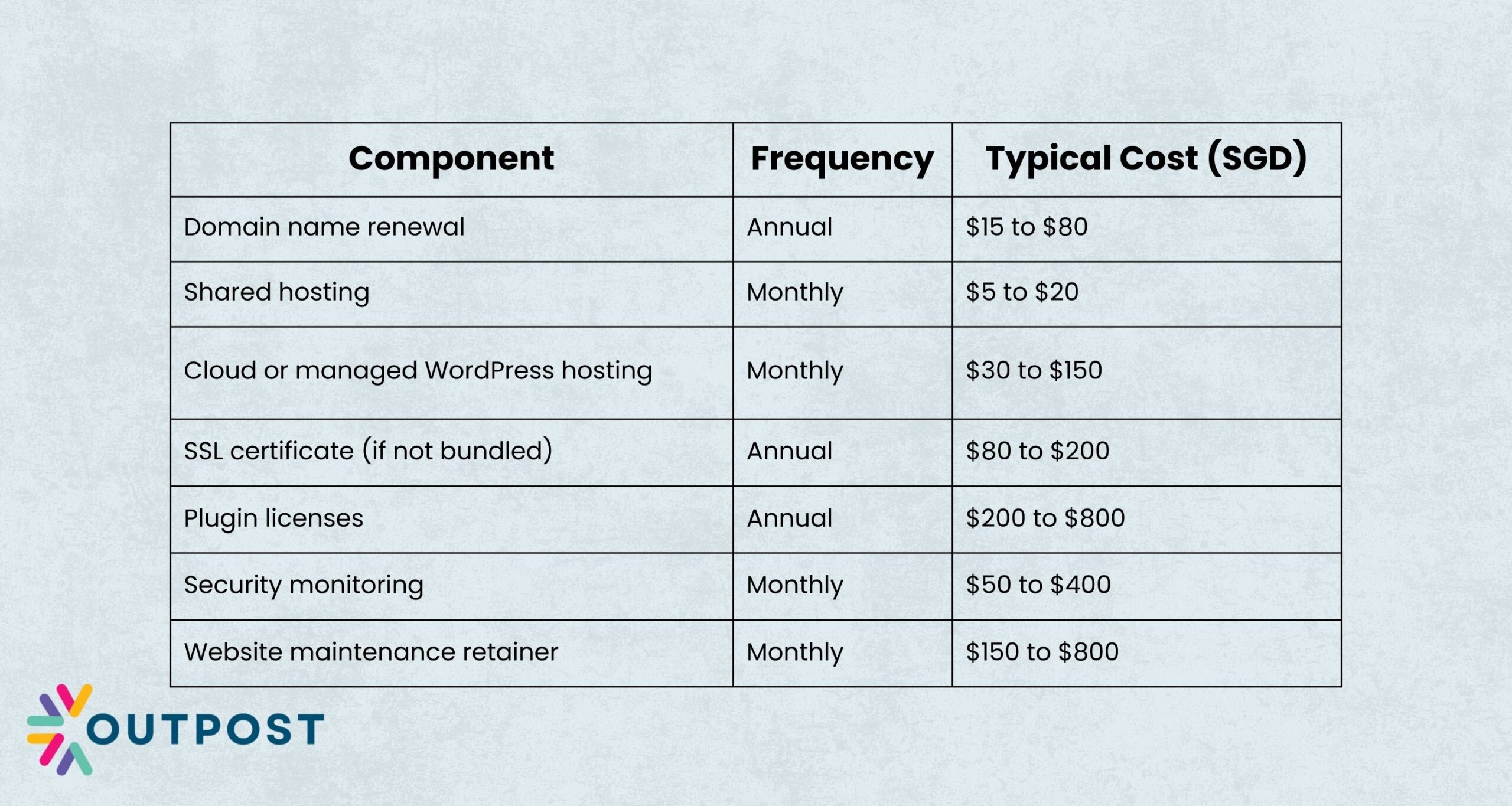
The design invoice is just the upfront cost. Once your site is live, you are looking at ongoing expenses that keep it running, secure, and performing.
Skipping on these is where a lot of businesses get caught out.
Domain Name
A domain name registration for a standard .com sits between $15 and $50 per year. A .com.sg or .sg domain runs closer to $60 to $80 annually.
For official SG domain rules and pricing guidance, refer to SGNIC.
Many hosting providers offer a free domain name for the first year, so it is worth checking what is included in your web hosting plan before paying for it separately.
A free domain name deal bundles well with an annual hosting commitment and is a legitimate way to reduce first-year costs.
Web Hosting
Web hosting is a service that keeps your site accessible around the clock. For local businesses, choosing a hosting provider with servers physically close to your audience makes a real difference to page speed.
Faster load times reduce bounce rates and improve search rankings, so the hosting decision is more strategic than it sounds.
Many providers also position their packages as complete hosting solutions, bundling security, backups, and performance tools into a single service.
Evaluating these web hosting solutions carefully helps businesses match a provider to their real hosting needs rather than simply choosing the cheapest plan available.
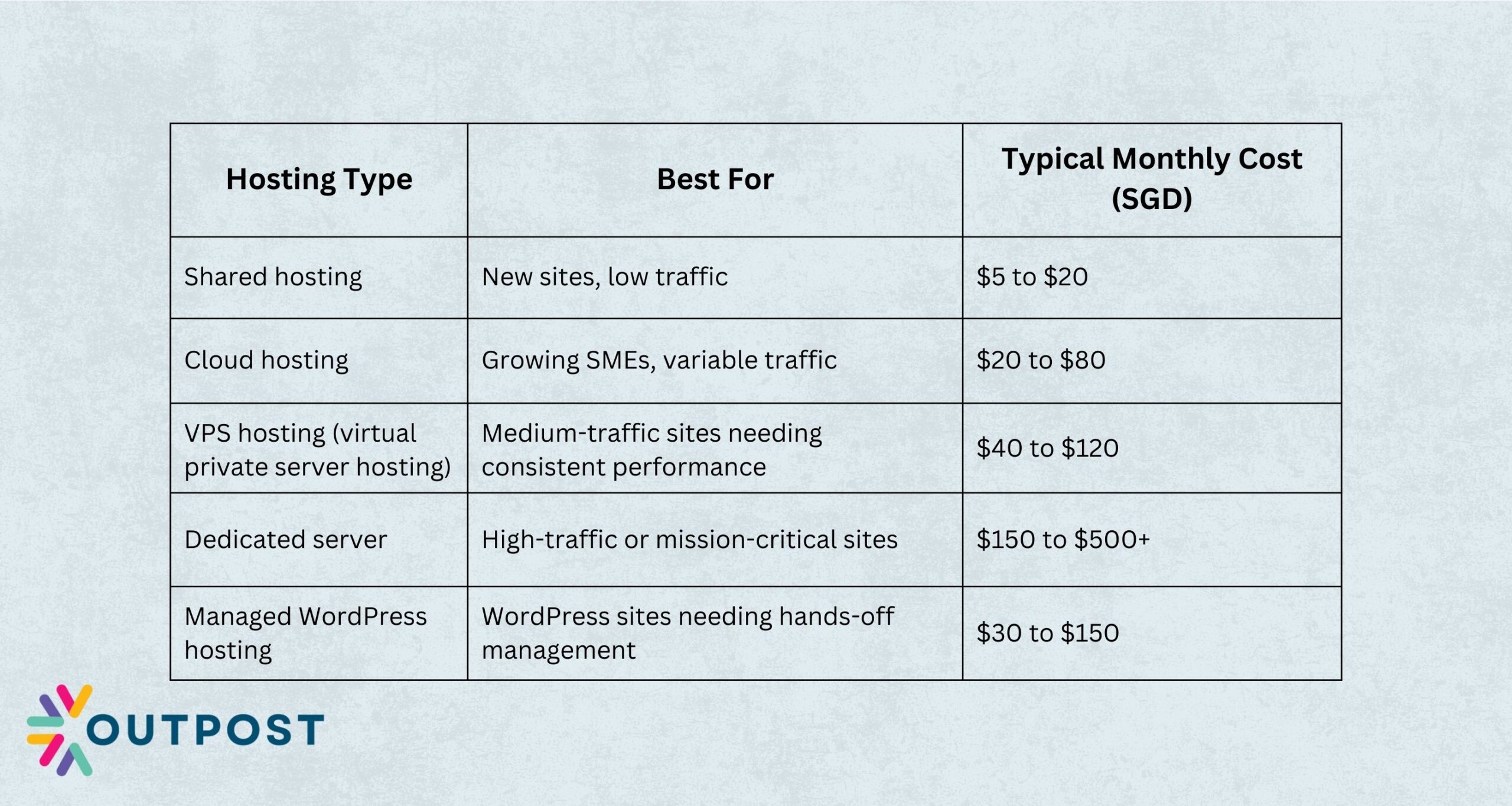
Here are the main hosting types you will encounter.
- Shared hosting puts your site on a server shared with other websites. It is the most affordable entry point, typically $5 to $20 per month, and suits smaller sites with modest traffic.
- Cloud hosting gives you more scalability and resilience. Traffic spikes are handled more gracefully, and it is a better fit for growing businesses than shared hosting.
- VPS hosting (virtual private server) sits between shared and dedicated server setups. A virtual private server gives you dedicated resources within a shared environment, which means more consistent performance at a mid-range price.
- Dedicated hosting gives you an entire server to your site. It is the most expensive option and is suited for high-traffic or mission-critical operations where downtime is not acceptable.
- Managed WordPress hosting is specifically optimised for WordPress sites. The hosting provider handles updates, security patching, and performance tuning. Many providers that offer managed WordPress hosting also include a free SSL certificate and automated backups as standard.
Flexible hosting plans that allow you to move between shared, cloud, and VPS as your business grows are worth prioritising when you are evaluating options.
Switching hosting providers mid-growth is a headache, so it pays to choose a provider with a clear upgrade path from the start.
SSL Certificate
A free SSL is included with most quality hosting plans today. If yours does not include it, a standalone SSL certificate costs $80 to $200 per year. Learn more about free SSL from Let’s Encrypt.
This is non-negotiable. Without one, browsers flag your site as insecure and visitors leave immediately.
Maintenance
Plugins need updating, security patches need applying, and content needs refreshing. If this is not handled internally, budget for a monthly maintenance retainer.
In Singapore, this typically runs from $150 to $800 per month depending on how complex the site is.
9 Best Website Hosting Providers in Singapore
Vodien
Vodien is one of the most established hosting companies in Singapore. Founded in 2002, it operates infrastructure within Singapore and focuses heavily on local SME support. Businesses that prioritise data residency, local support teams, and predictable performance often choose Vodien as their primary hosting provider.
Hostinger
Hostinger is a global hosting provider known for its competitive pricing and strong performance for smaller websites. It offers modern infrastructure, NVMe storage, and a beginner-friendly control panel, making it a popular choice for startups and SMEs looking for cost-effective hosting.
SiteGround
SiteGround is widely recognised for its strong customer support and performance-focused hosting environment. It offers managed WordPress hosting, automated backups, and integrated security tools, which makes it attractive for businesses that want reliable performance without heavy technical management.
Bluehost
Bluehost is one of the most widely known hosting providers globally and is officially recommended by WordPress. It provides beginner-friendly hosting plans, simple setup processes, and scalable infrastructure, making it suitable for businesses launching their first website.
Exabytes
Exabytes is another hosting provider with strong roots in Southeast Asia. It offers hosting plans designed specifically for regional businesses, including cloud hosting, business email hosting, and domain management services.
A2 Hosting
A2 Hosting focuses heavily on performance and speed optimisation. Its infrastructure is designed to deliver faster page load times, which can help businesses improve user experience and SEO performance.
Cloudways
Cloudways offers a different approach compared to traditional hosting companies. Instead of owning data centres, it provides a managed cloud hosting platform that runs on infrastructure from providers like DigitalOcean, AWS, and Google Cloud.
GoDaddy
GoDaddy is one of the largest domain registrars and hosting providers in the world. Many businesses choose GoDaddy for the convenience of managing domain registration, hosting, and website tools within one platform.
DreamHost
DreamHost is another long-standing hosting provider with a reputation for transparency and reliability. It offers WordPress-focused hosting, strong uptime guarantees, and straightforward pricing structures.
Choosing the Right Web Hosting for a Singapore Business

Singapore web hosting options split broadly into local providers and international ones, and both have legitimate cases for different types of businesses.
Several popular hosting companies operate in this market, offering plans designed specifically for SMEs with different performance and pricing requirements.
The Case for Local Hosting
Local hosting means your site data sits in a Singapore data center. This shortens the physical distance data travels to reach your visitors, which directly improves load times for a local audience.
A data center in Singapore also makes PDPA compliance considerably easier to manage, since your data stays within the country. Businesses handling sensitive customer information or operating in regulated industries tend to find this a more comfortable arrangement.
Some hosting providers have run Singapore servers since the early 2000s and have built long-standing reputations on uptime and local support.
Working with a hosting company in Singapore gives you easier access to local support and clearer accountability when issues arise.
Many of these providers are based in Singapore and operate infrastructure across multiple data centre locations in Singapore to ensure redundancy and uptime.
Spotlight: Vodien (Local Specialist)
Vodien is one of the most established hosting companies in Singapore, with a hosting experience that dates back to 2002.
The company has been delivering hosting since the early days of Singapore’s commercial internet industry, which contributes to its long-standing reputation among local SMEs.
- Long-term Expertise: As a Singaporean web host that has been in the market for over two decades, Vodien offers a wide range of hosting packages covering shared and cloud hosting, VPS, and dedicated server configurations.
- Scalability: A business in Singapore can start on an entry-level web hosting plan and scale up without needing to switch providers.
- Support: The hosting company in Singapore is well known for its local support team, which understands the environment that local SMEs operate in and responds faster than most international alternatives.
Spotlight: Hostinger (International Option)
International web hosting providers bring global infrastructure and often sharper introductory pricing.
Hostinger is consistently among the best web hosting companies for SMEs looking for performance at a competitive price.
- Performance & Price: With NVMe storage, a modern control panel, and hosting plans starting well below $10 per month, it is a strong web hosting provider in Singapore for businesses getting started.
- Added Value: Hostinger also includes free website migration for customers moving from another provider.
- Market Standing: Singapore offers a mature enough hosting market that businesses can choose between local and international providers confidently, and Hostinger remains one of the best web hosting in Singapore options for cost-conscious SMEs.
For best hosting for Singapore at startup-friendly pricing, it regularly comes out near the top of comparison lists.
It frequently appears in lists discussing the best web hosting providers globally, and it is evaluated in comparisons for both best web hosting Singapore options and best web hosting for Singapore startups entering the market.
Key Evaluation Criteria
When you are evaluating web hosting companies, the questions to ask are consistent regardless of whether you are looking at a local or international provider:
- Does the hosting provider have Singapore servers or a data center in Singapore?
- What is the uptime guarantee and what does the SLA say about downtime compensation?
- Does the web hosting plan include email hosting, a free domain name, or a free SSL?
- What are the renewal rates after the first year?
- Is there a clear upgrade path between different types of hosting as traffic grows?
A Note on Email Hosting
Email hosting is worth a specific mention. Keeping your business email accounts on a hosting arrangement separate from your main site means your communications stay up even if your website goes down.
Many web hosting companies in Singapore bundle email accounts with their plans, but this is not universal, so it is worth confirming before committing.
Local vs International Hosting for Singapore Businesses
The question of whether to use a singapore web hosting provider or an international one comes up a lot. The honest answer? It depends entirely on where your customers are located.
Why Choose Singapore Web Hosting?

If your audience is primarily based locally, choosing a provider with servers in Singapore gives you the fastest possible load times. For any website in Singapore targeting a local customer base, this speed advantage is real and measurable.
Key benefits of staying local:
- Reduced Latency: Physical proximity to your users means pages snap open instantly.
- Data Residency: Easier compliance with local regulations (like PDPA).
- Local Support: Customer service that operates in your time zone and understands the local market.
There are many reputable hosting companies available in Singapore with proven track records on uptime and support. These web hosting services often include website management tools and security monitoring as standard.
When to Consider an International Host
For businesses serving a regional or global audience, an international web host with servers across multiple locations may provide better overall reach.
The range of hosting plans from global providers often includes Content Delivery Networks (CDNs), which keep load times fast for visitors whether they are in London or New York. Furthermore, hosting for Singapore offers from international giants have become incredibly competitive, often outperforming local options on pure technical scalability for high-traffic sites.
Finding the Right Hosting Type for Your Needs
Different hosting options suit different business profiles. The key is matching the plan to your actual needs:
- Shared & Cloud Hosting: Ideal for most SMEs at different stages of growth.
- Managed Solutions: Best for those who want to avoid technical management.
- Dedicated Infrastructure: Necessary for high-security or high-traffic corporate sites.
The choice for web hosting comes down to your current traffic, your growth trajectory, and your budget. A reliable hosting provider in Singapore can help you identify the right entry point and scale your resources as your business grows.
Whether you opt for a local setup or a well-regarded international provider, prioritize a partner that offers strong hosting support and reliable server infrastructure.
Comparing Hosting Types Side by Side
Government Grants That Can Reduce Your Web Designing Cost
Singapore businesses have real financial support available for digital projects, and it is worth factoring this in before you finalise any budget.
The Productivity Solutions Grant (PSG) supports the adoption of pre-scoped digital solutions, including website development, e-commerce platforms, and digital marketing tools.
To qualify, your business must be registered and operating locally, maintain at least 30 percent local shareholding, and use the solution within Singapore. Working with a pre-approved vendor simplifies the process considerably and reduces the risk of rejection.
The Enterprise Development Grant (EDG) covers more complex digital transformation projects and can fund a portion of custom web application development or significant platform upgrades.
The Business Grants Portal is the most reliable source for current eligibility criteria and approved vendor lists, since grant parameters change periodically.
Some web design agencies in Singapore are experienced with the application process and can guide you through it, which makes the whole thing less painful.
Using these grants can cut your effective web designing cost substantially, and businesses that skip this step are often leaving money on the table.
What to Watch For When Getting Quotes
The web design market in Singapore has a wide range of vendors, and the quality gap is real. A few things to look out for before you commit.
- Quotes without an itemised scope of work almost always lead to disappointment. If the brief is vague, the output will be too.
- Ownership of your assets matters more than most people realise upfront. You should have full administrator access to your domain name, hosting account, and all website files from day one.
- Some packages lock you into proprietary platforms that are difficult or expensive to leave. Always ask what happens to your site if you decide to change providers.
- A vendor who does not mention ongoing maintenance, security updates, or backups at any point during the sales conversation is not thinking about your long-term interests.
- Design-heavy pitches that never mention page speed, mobile performance, or SEO are a red flag. A website that looks good but loads slowly and ranks nowhere is not delivering business value.
Planning Your Budget Realistically
The most practical approach is to start from your business objectives and work out what the site needs to achieve, then figure out what that costs.
A website that generates five additional client enquiries per month at an average deal size of $5,000 pays for itself within the first quarter. That framing makes the investment easier to justify and helps you decide where to spend more and where to keep costs tight.
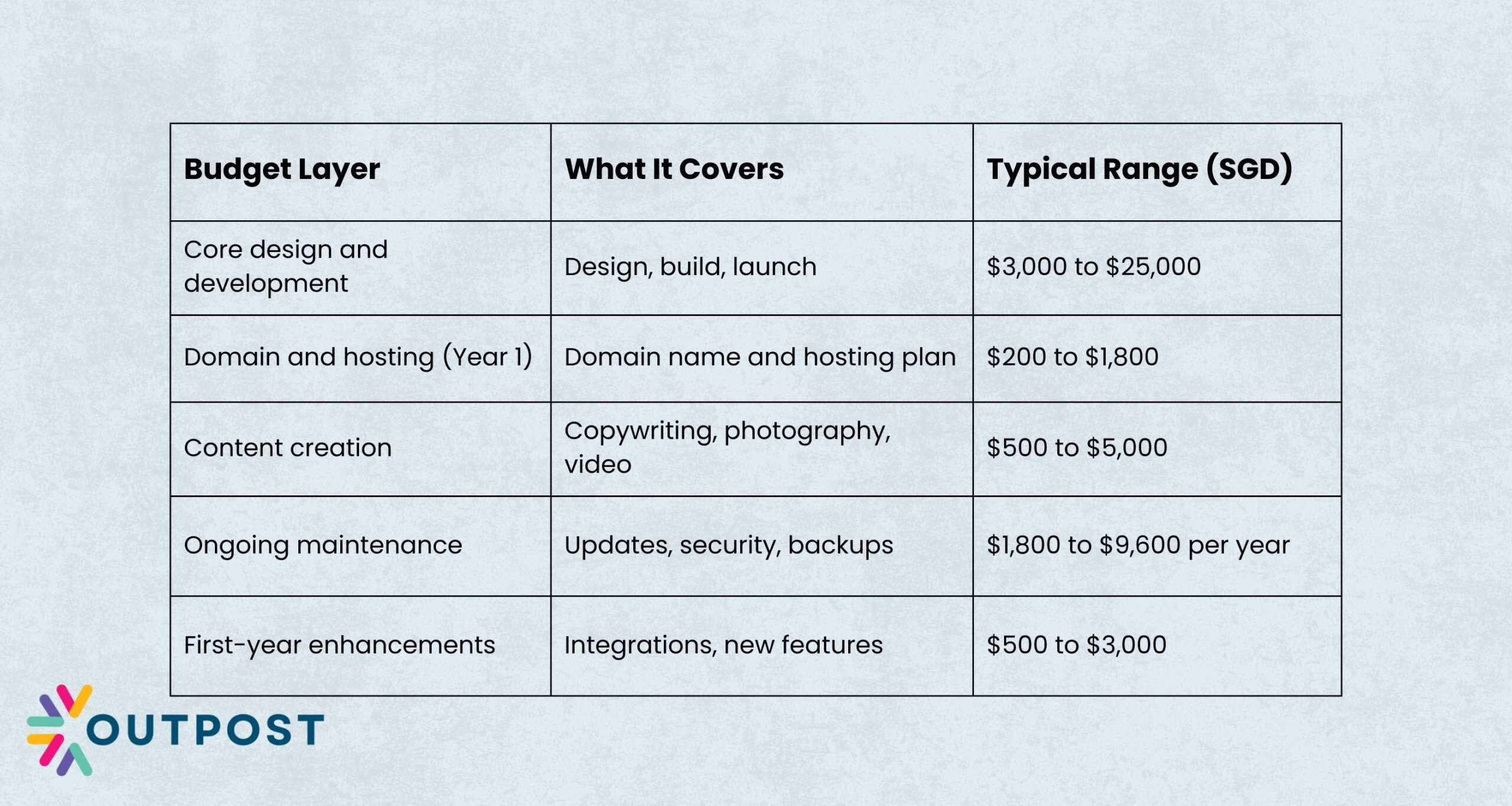
Build the budget in layers: the core design and development cost, domain and hosting for the first year, content creation if you are not handling it internally, ongoing maintenance, and any first-year additions like a booking system or live chat integration.
What a Well-Built Website Actually Does for Your Business
A site that loads quickly, works on mobile, and is built on a technically sound foundation does more than just look professional.
It ranks better in search, converts more visitors into leads, and holds up under traffic spikes without breaking. These are not nice-to-haves.
Google’s Core Web Vitals measures page loading speed, interactivity, and visual stability as direct ranking signals.
If the hosting is slow, those scores drop, and the site ranks lower. Hosting is a service with real SEO consequences, and Singapore businesses that treat it as a commodity end up paying for it in lost rankings.
The best web hosting companies understand this and engineer their infrastructure accordingly.
The best value web hosting is not the cheapest option available. It is the one that keeps the site fast, secure, and reliable at a price that makes sense for where the business is right now.
A web application firewall adds another layer of protection, blocking malicious traffic before it reaches the site. Some managed hosting providers include this as standard.
For businesses handling customer data or running e-commerce operations, it is worth confirming whether your hosting plan includes one or whether it needs to be added separately.
How Outpost Fits Into Your Digital Operations
Once a website is live, the ongoing work of producing content, running campaigns, managing updates, and optimising performance is what actually drives results.
A lot of SMEs build a solid site and then let it sit untouched for months because they do not have the internal capacity to keep up with it.
Outpost is a virtual staffing agency that helps businesses build dedicated remote teams.
For businesses whose digital workload has grown beyond what a single agency engagement can handle, Outpost provides specialists in content, web operations, and digital marketing who work directly within the business’s workflow.
Including web design and digital support as part of an ongoing staffed team is how growing businesses make sure the investment in their website keeps paying off over time.
This is not a replacement for an agency on the initial build. It is the operational layer that keeps things moving after launch.
Final Thoughts
Web designing cost in Singapore is not a fixed number, and it should not be treated as one. The Infocomm Media Development Authority publishes practical digital adoption resources for SMEs.
What you spend depends on what you need the site to do, who builds it, and how well you plan for the ongoing costs that follow launch.
The businesses that get the most out of their website investment are the ones that go in with a clear brief, a realistic budget that accounts for hosting and maintenance, and a plan for who is managing the site after it goes live.
Get multiple quotes and compare them on scope. Check whether you qualify for PSG or EDG grants before finalising any budget. And find the best hosting provider for your current stage of growth, with clear room to scale as traffic increases.
Done right, your website is one of the most cost-effective business assets you can invest in.
About the Author: Tansi G