


If you have been trying to figure out web designing cost before talking to any agency, good.
Most business owners go into those first conversations blind and end up overpaying or choosing the wrong partner because they had nothing to compare against.
This guide lays out what businesses in Singapore actually pay in 2026, what pushes the price up or down, and how to make a decision you will not regret.
A good website needs a marketing team behind it to do anything useful. If your internal team is stretched, virtual staffing agencies like Outpost help SMEs bring on trained remote staff to handle content and campaigns without the overhead of a full-time hire.
What Affects Website Design Cost in Singapore
The reason web design cost in Singapore varies so much is not mysterious. Two businesses with seemingly similar briefs can receive quotes that differ by S$15,000. Here is what actually drives that gap.
Scope is the biggest factor.
A five-page site and a thirty-page site are not the same job, even if both are called business websites. Every additional page in a web design project adds design, development, and often copywriting time.
Every web design and development engagement is scoped by page count first, and the overall cost follows from there.
Customisation level is the second major variable.
Template builds cost less because the foundational work has already been done by someone else.
Custom web design, built from scratch with original wireframes and bespoke UI components, costs more because every hour goes toward your project specifically. The design company in Singapore you hire is building something that did not exist before, and that takes time.
Ecommerce requirements change the equation significantly.
An ecommerce website involves payment gateway integration, inventory logic, product filtering, customer accounts, and checkout flow optimisation. A standard business website does not.
The more complex your catalogue and fulfilment requirements, the more the development cost adds up. This is one of the areas where the final cost depends most heavily on the details of your brief.
Integrations matter too.
If your website needs to connect with a CRM, a booking system, or a WhatsApp API, each connection requires its own scoping, development, and testing.
These integrations add to the overall cost in ways that are not always visible in the initial quote. Web applications with custom backend logic sit at the higher end of design services in singapore pricing for exactly this reason.
Content creation is often excluded from quotes.
If your agency is writing the copy for your pages, that can add S$2,000 to S$8,000 to the total depending on volume. Web designers and developers working alongside a writer will deliver better results, but the combined cost reflects that.
Timeline pressure adds cost.
Agencies that can take a rushed project will typically charge a premium. If your launch date is flexible, you will almost always get a better number.
Web Design Cost in Singapore: Full Pricing Breakdown 2026
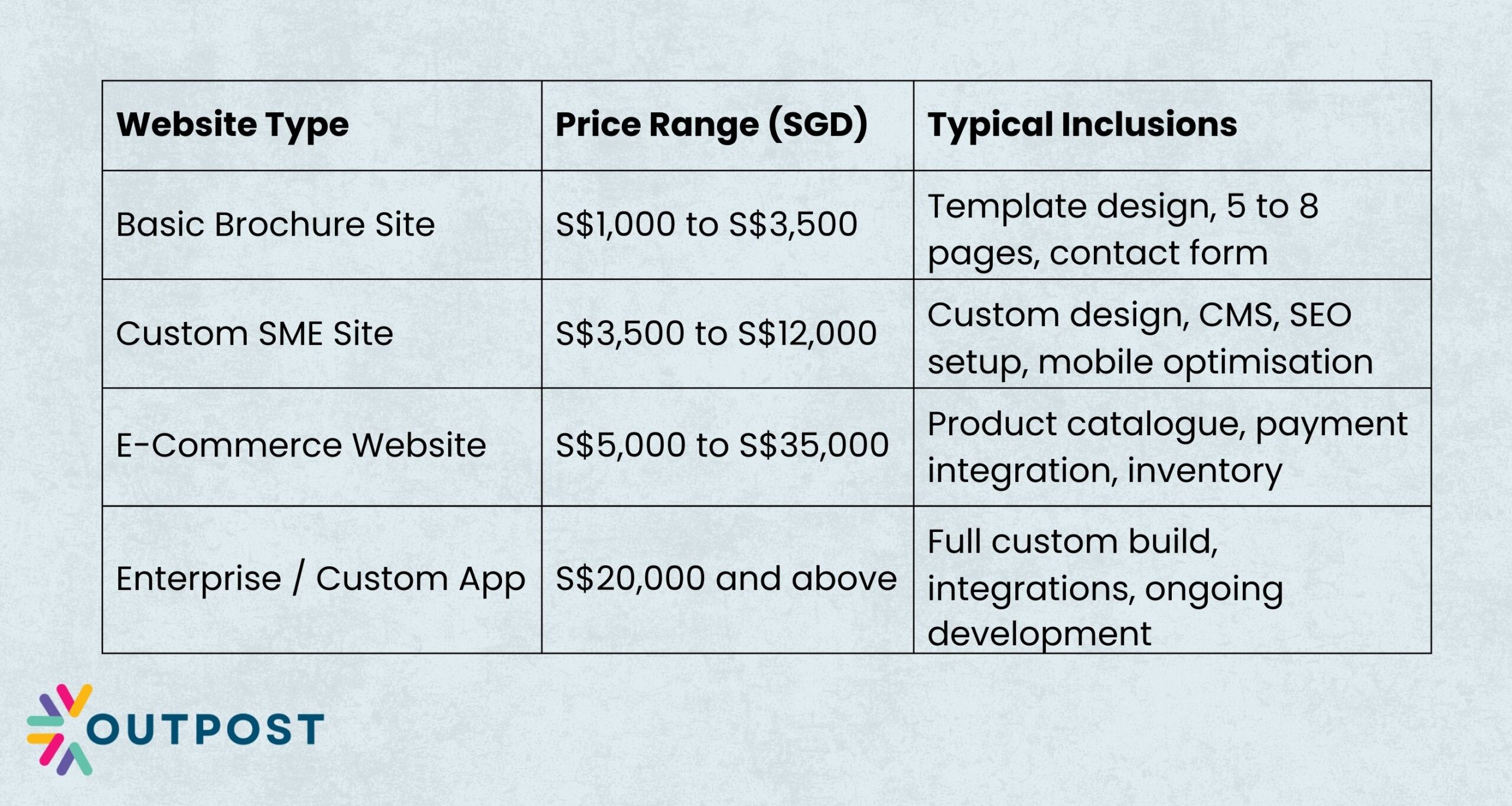
Here is how website design cost in Singapore breaks down across the most common project types. Understanding the website design price at each level helps you benchmark quotes properly.
These are real market figures for website design in Singapore, not padded estimates. The cost of web design here reflects what local agencies and freelancers actually charge.
Basic Brochure Website: S$1,000 to S$3,500
A site at this price point typically covers a homepage, about page, services overview, and contact form. Design is template-based with your brand applied on top.
For a startup or sole proprietor who needs a credible web presence to back up referrals, this range works fine. Basic websites often lack the technical SEO infrastructure needed to rank competitively, which matters if organic traffic is part of your growth plan.
Custom SME Business Website: S$3,500 to S$12,000
This is where most established small businesses in Singapore sit. At this level, a professional web design agency will spend time understanding your business before designing anything. You get a site built around your customer journey.
Standard inclusions are mobile-first responsive design, a basic SEO setup, a CMS so your team can make changes without calling a developer, and lead capture forms.
The cost of website development here reflects the thinking behind the structure.
E-Commerce Website: S$5,000 to S$35,000
Singapore can range from SGD 5,000 for a modest product catalogue with standard checkout to SGD 35,000 or beyond for a fully custom platform.
The ecommerce platform you choose affects the final cost significantly.
Shopify builds sit at the lower end because the platform handles most of the backend infrastructure.
The cost between SGD 5,000 and S$35,000 covers most cases, and the final cost depends on several factors specific to your business.
Enterprise and Custom Web Applications: S$20,000 and above
Larger organisations and businesses that need genuinely bespoke web applications should expect to invest significantly more.
These projects run across multiple development sprints with dedicated project management, user testing, and ongoing post-launch iteration.
Web development at this level is closer to building a software product than designing a website.
Freelancers vs Agencies: What You Actually Get for the Money
This is one of the most practical decisions in the whole process.
A freelance web designer typically charges between S$800 and S$4,000 for a complete project. Lower overhead means better value on simpler builds.
Singapore has a solid pool of capable freelance web designers who can do genuinely good work at accessible prices.
The risk shows up on complex projects. A freelancer managing design, development, copywriting, and SEO at the same time will either take longer or sacrifice quality in one area.
There is also the continuity issue: if they become unavailable after launch, handing off their custom code to someone new is not always straightforward.
Web design agencies bring more structure. Web design services in Singapore span a wide range of agency types, from boutique studios to full-service firms.
A boutique Singapore web design agency gives you a more personal experience while covering more ground than any individual freelancer.
Most assign a dedicated account manager so there is one clear point of contact. Professional web design services at agency level cost more, but what you are paying for includes project management, quality assurance, and the capacity to handle scope changes without things falling over.
For a straightforward site with a tight budget, hiring a web designer who works independently is usually the smarter move.
For a custom build, an ecommerce project, or anything requiring post-launch support, an agency offers structure and continuity that a solo designer cannot always provide.
Whether you choose a freelancer or full agency, the decision should match the complexity of what you are building.
9 Web Design Agencies in Singapore Worth Knowing
Choosing a web design partner in Singapore means sorting through a crowded market. Web design in Singapore has matured significantly over the last few years, and these nine agencies represent a real cross-section of what is available locally.
1. First Page Digital
Known for building sites structured around search performance from day one. Every page is architected with ranking in mind. Good fit for businesses with aggressive SEO goals.
2. OOm Pte Ltd
A Google Premier Partner with strong technical authority, especially in ecommerce. The team focuses on sites that handle real traffic volume while keeping conversion rates healthy.
3. Heroes of Digital
Uses an AI-based tracking system to monitor lead behaviour post-launch. Popular with service businesses like clinics and law firms that need a direct link between web investment and inbound leads.
4. Verz Design
One of the more established names in the Singapore web design market. Covers photography and copywriting alongside web design, which is useful if you want one vendor managing multiple brand deliverables.
5. ALF Design Group
Specialises in Webflow builds with complex animations and strong mobile performance. Mobile-friendly and responsive design is central to how the studio works. The aesthetic suits lifestyle and creative brands.
6. Impossible Marketing
A good entry point for heartland SMEs new to digital. Transparent pricing, workshop access, and a practical SEO focus make it approachable for owners who want to stay closely involved.
7. Construct Digital
Consultative and thorough. Construct maps the full customer journey before any design work begins. Best fit for B2B companies where the website needs to nurture leads over a longer cycle.
8. Vinova
Developer-led and technically rigorous. For businesses that need bespoke web applications, member portals, or complex system integrations, Vinova’s engineering depth is the main draw.
9. Codigo Singapore
Brings consumer app-level UI and UX craft to web design. The right fit for brand-conscious businesses where the website needs to feel genuinely premium.

Key Factors That Affect Web Design Pricing
Understanding what goes into a quote helps you figure out where the money is actually going.
UX research and wireframing add cost upfront but save money later.
Agencies that map user flows and identify friction points before opening any design software are the ones that produce sites that actually convert.
Skipping this phase is one of the most common reasons sites get redesigned within two years.
Mobile-friendly design is not optional in 2026.
Google indexes the mobile version of your site first when deciding where it ranks. A site that is not properly optimised for mobile will hurt your visibility regardless of how good the desktop version looks.
For reference, Google’s mobile-first indexing guidelines are publicly available.
SEO setup is often where the difference between a site that gets found and one that sits invisible lies.
Clean URL structures, schema markup, compressed images, and properly configured meta tags are not visible to the eye but affect your rankings significantly. Some agencies include this as standard. Others charge separately. Always ask.
Content management systems matter for long-term costs.
A CMS means your team can update the site without hiring a developer every time.
Website maintenance gets cheaper when you are not paying hourly rates to change a phone number or swap a banner image. WordPress is the most common choice in Singapore. Webflow and Squarespace are popular for design-forward projects.
Post-launch support is something most businesses underestimate.
Expect to pay between S$150 and S$400 a month for a maintenance plan covering software updates, security monitoring, and minor content changes.
Website performance over time depends heavily on whether someone is actually keeping the site healthy.
Choosing the Right Web Design Partner
Many web design agencies often specialise in specific sectors, and that match matters more than most people realise.
An agency with a strong ecommerce portfolio will approach a B2B services project very differently from one that has spent years building service firm websites.
The web design cost Singapore market is broad enough that you have real options, so use them.
Get three to five proposals before committing. Costs in Singapore can vary greatly even among agencies at the same tier.
The average cost of a professional SME site sits around S$5,000 to S$8,000, but the overall cost of your specific project depends on scope. Comparing proposals teaches you a lot about how each web agency thinks and what they actually prioritise.
Planning your website design budget before those conversations start makes every meeting more productive.
Arriving with a number in mind leads to better conversations.
The right web design agency will always work within a defined budget ceiling more transparently than one given no parameters. Website design and development in Singapore quotes vary widely, so knowing your range helps you filter faster.
Web design agencies often include a discovery phase in their proposals. The quality of questions an agency asks during discovery is a better signal than their portfolio.
Good questions mean they are actually trying to understand your business.
Government Grants for Web Design in Singapore
Singapore businesses have real grant options worth using. The Productivity Solutions Grant (PSG) is the most accessible for SMEs.
Government grants for web design through the PSG can cover up to 50 percent of the cost, as long as you use a pre-approved vendor. Your business must be registered in Singapore with at least 30 percent local shareholding to qualify.
Applications go through the GoBusiness portal (gobusiness.gov.sg). Processing takes time, so apply before you sign anything with an agency.
The Enterprise Development Grant (EDG), run by Enterprise Singapore, is another option for more complex digital transformation projects that go beyond a standard website build.
Check vendor approval status before committing to anyone. Every website in Singapore in 2026 that receives PSG funding must be built by a pre-approved vendor, and you cannot apply for the grant after the fact.
DIY vs Professional Web Design
Website builders like Wix, Squarespace, and Webflow have made it possible for a non-technical founder to publish something functional without any development knowledge. A DIY website on one of these platforms typically runs S$20 to S$60 a month.
The cost of a website through this route is significantly lower than hiring a professional.
For a brand new business testing a concept, a DIY site is a rational first step. The limitations become real once your requirements grow. Website builders cap what you can customise and make complex integrations difficult.
A website can help a business generate serious revenue, but only if it is built to do that.
Hiring a professional web designer gives you a site built around your specific business goals and your customers, not the defaults of a template.
The upfront cost is higher, but a well-built professional site almost always outperforms a DIY alternative on search visibility, conversion rate, and brand credibility over time.
The overall website design cost for a professional build is an investment that most businesses recover within a year through improved lead generation, assuming the site is maintained properly.
How Outpost Supports Your Marketing Team
Getting a website built is one thing. Keeping it performing is another. Most SMEs find the real bottleneck is not the website but the marketing activity behind it. Content needs publishing. Campaigns need running.
Outpost is a virtual staffing agency that helps Singapore businesses scale their marketing capacity without committing to additional full-time salaries.
Businesses work with Outpost to bring in trained remote staff who slot into existing workflows and handle the digital tasks that keep a website useful after launch.
A site with consistent content behind it will outperform a better-designed site that gets ignored. For more on how the model works, visit Outpost.
Planning Your Web Design Budget

Before you speak to a single agency, be honest about what your site needs to do.
Start with your primary objective.
Is the website there to back up referrals? To generate organic leads? To process transactions? That answer should drive how much you invest.
Separate the one-time cost from the recurring costs.
The design project price is paid once. Hosting, domain renewal, maintenance, and content production come back every year.
The total annual cost of running a professional website in Singapore, including all recurring expenses, typically sits between S$5,000 and S$20,000 depending on scope.
Budget for content.
Every page needs text, images, and sometimes video. Projects without a content plan almost always run over budget.
Leave a buffer of 15 to 20 percent on the quoted project cost for scope changes.
And plan your web design budget with the PSG grant in mind before ruling anything out. It can cut your effective web designing cost by up to 50 percent.
FAQs: How Much Does a Website Cost in Singapore?
How much does a web designer cost in Singapore?
A freelance web designer in Singapore typically charges S$800 to S$4,000 for a complete project. Agency rates for professional website design start from around S$3,500 and scale based on scope.
What is the average ecommerce website price?
Most ecommerce builds cost between S$5,000 and S$20,000 for a mid-range project. Heavily customised platforms with complex inventory or multi-currency support can reach S$35,000 or beyond.
Is custom web design worth it for SMEs?
For most established businesses with clear business goals and an existing customer base, yes.
A well-built custom site generally recovers its cost within 12 to 18 months through improved conversions and search visibility.
What ongoing costs should I expect?
Budget S$150 to S$400 per month for maintenance, S$200 to S$600 per year for hosting, and S$15 to S$60 per year for domain renewal.
SEO and content costs vary based on your marketing activity.
Should I hire a freelancer or agency?
For a simple site on a tight budget, hiring a professional web designer who works independently is usually better value.
For a complex build or anything requiring post-launch management, a professional web design agency earns its premium.
Hiring a web designer on a freelance basis works best when your scope is clear and contained.
Choosing a Partner and Moving Forward

Web designing cost in Singapore spans an enormous range. What matters is matching your investment to your actual needs. Get clear on your business goals first. Research partners whose portfolio and process fit your context.
Use the PSG grant to bring your effective cost down. Do not underestimate the ongoing work that turns a website into something that keeps performing.
The Infocomm Media Development Authority publishes practical resources for Singapore SMEs on digital tools and grants.
Forbes covers small business digital investment regularly at forbes.com. Web design trends continue to shift toward performance and AI readiness, so staying informed matters beyond the initial build.
About the Author: Tansi G