


Understanding your website maintenance costs is one of the most overlooked yet critical decisions an SME can make.
Too many business owners treat their website like a set-and-forget asset, and then face a costly emergency that could have been entirely prevented.
In Singapore’s competitive digital landscape, keeping a website healthy and current is not a luxury; it is the foundation of your brand’s credibility and search visibility.
This guide breaks down every component of website maintenance cost in Singapore. From domain renewals and web hosting to SSL certificates and technical support.
Whether you run a simple brochure site or a full ecommerce store, there is a tier here that fits your needs and your budget.
Businesses looking to scale their marketing operations without expanding headcount can also explore virtual staffing solutions at Outpost to complement their in-house teams.
Read on for a full pricing breakdown, practical cost-saving tips, and the key questions every Singaporean SME should ask before signing a maintenance agreement.
How Much Does Website Maintenance Cost in Singapore?
Website maintenance costs can range quite dramatically depending on what your site needs.
A basic informational site for a sole proprietor has very different requirements from a high-traffic corporate website with ecommerce integrations and API connections.
On the low end, a standard SME might spend S$300–S$800 per month. Enterprise-grade platforms with dedicated support and round-the-clock coverage can exceed S$5,000 monthly.
The cost to maintain a website in Singapore is influenced by the type of website you operate, the complexity of the website, the hosting environment you choose, and the level of service included in your agreement.
Before diving into individual line items, here is a high-level overview of what most businesses can expect to pay across four common tiers.
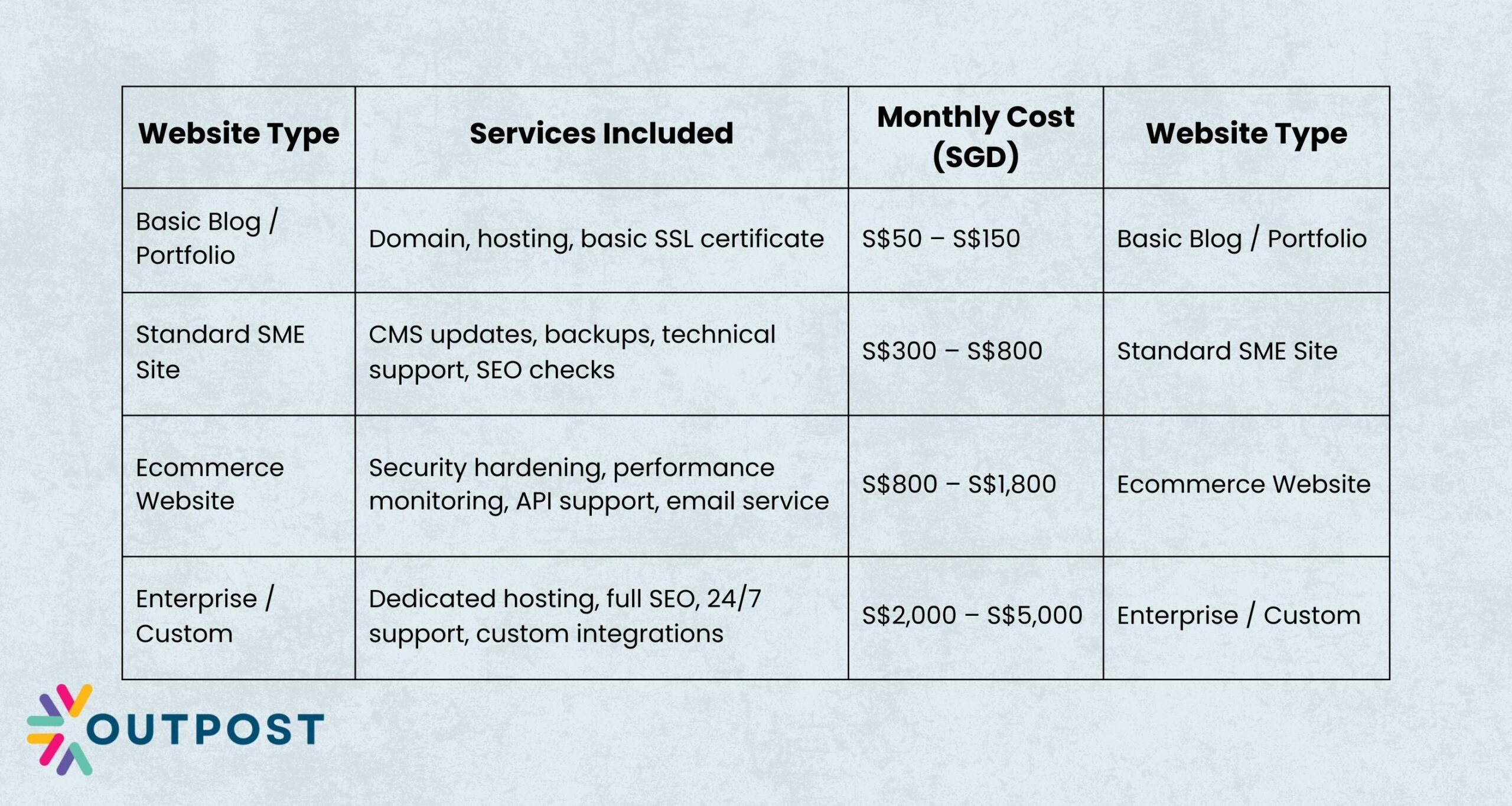
Understanding the Core Components of Website Maintenance Costs
Knowing the total figure is only the first step.
Breaking down each component helps you understand where your budget is going and where you can potentially trim costs without sacrificing quality.
The following nine categories represent the essential recurring costs every website owner should plan for.

1. Annual Domain Name Renewals
Your domain name is your address on the internet, the very first element a potential customer encounters when searching for your brand. Unlike physical property, you do not own a domain name outright.
Businesses renew their registration annually through a domain registrar, and domain name costs vary based on the extension you choose.
In Singapore, the most commonly used extensions are .com and .sg.
A standard .com domain typically costs S$30–S$50 per year — as low as S$10 per year at budget registrars. A .sg or .com.sg domain runs slightly higher at S$50–S$80 annually.
Neglecting renewal can be catastrophic: a lapsed domain can be snapped up by competitors or domain squatters who will resell your brand identity back at a significant premium.
Most registrars offer auto-renewal, which is a simple safeguard worth enabling immediately.
It is also worth confirming whether domain privacy is included or charged separately. Some providers bundle it for free, others charge around S$15 per year.
This service conceals your personal contact details from public WHOIS records and reduces spam exposure significantly. For reference, find out how SG domain registrations are regulated.
2. Web Hosting Infrastructure
Web hosting is arguably the most consequential decision in your maintenance budget.
This is where your website’s files physically reside, and the quality of your hosting plan directly affects how fast pages load, how reliably your site stays online, and how well it ranks in search results.
The cost of web hosting varies widely based on the type of server environment and the level of service you select. Here is a breakdown of the most common hosting available for Singapore businesses:
- Shared hosting (S$200–S$500/year): The most affordable entry point, where multiple sites share a single server’s resources. Suitable for low-traffic or early-stage businesses, though performance can dip if a neighbouring site experiences a traffic spike.
- Cloud hosting / Managed WordPress (S$600–S$1,000/year): A popular middle ground for growing SMEs. The hosting service handles server-level configurations and security patches on your behalf, reducing the technical burden on your team considerably.
- VPS or Dedicated hosting (S$1,500–S$5,000+/year): Designed for high-traffic business websites and ecommerce sites that cannot afford downtime. The type of hosting you choose at this tier determines whether you share any server resources at all.
For Singaporean businesses, prioritising local or regional hosting solutions is strongly recommended. A server physically located in Singapore ensures data travels a shorter distance to your users, resulting in faster load times — a primary factor for both user experience and search engine rankings in 2026.
3. SSL Certificate and Website Security
An SSL certificate — which stands for Secure Sockets Layer — creates an encrypted tunnel between your server and your visitors’ browsers. This is the technology behind the padlock icon in your address bar.
Without it, modern browsers display a “Not Secure” warning that immediately erodes visitor trust and suppresses conversions.
Most reputable hosting providers include a free SSL certificate through Let’s Encrypt as standard.
However, businesses that process payments or handle sensitive customer data should consider stepping up to an Organisation Validated (OV) certificate, which also verifies that the issuing entity is a legitimate registered business. These typically cost between S$100–S$300 per year.
Security expenditure extends well beyond the SSL layer. A comprehensive setup should include a web application firewall to block malicious traffic, automated malware scanning, and a defined incident response protocol.
Monthly security plans from reputable providers generally range from S$50–S$100 per month, offering continuous monitoring and rapid remediation if an intrusion occurs.
4. Content Management System and Plugin Maintenance
The vast majority of business websites in Singapore are built on a content management system such as WordPress — one of the most widely supported platforms for web development globally.
These platforms are powerful and flexible, but they require consistent upkeep through CMS core updates, plugin management systems reviews, and compatibility checks.
Plugins are modular extensions that power specific site features. Forms, galleries, payment gateways, and live chat tools all typically run via plugins.
A healthy business website may have between 10 and 20 active plugins, each requiring individual updates and compatibility checks.
A single outdated plugin can introduce a vulnerability that exposes your entire database to attack.
Professional developers typically test updates in a staging environment before applying them to the live site. This prevents unexpected breakage that could take your site offline during business hours — a scenario far more expensive to fix than a monthly maintenance retainer.
Budget approximately S$500–S$1,000 per year for plugin license renewals alone, on top of developer time for routine maintenance tasks.
5. Content Refresh and Copywriting
Search engines reward websites that demonstrate consistent, high-quality activity. Regular content and design updates signal to Google that your site is an active, authoritative resource.
Keeping a website fresh with new articles, updated service pages, and accurate pricing information is one of the highest-leverage maintenance activities available to SMEs.
A well-researched blog post from a reputable Singapore-based writer typically costs S$200–S$500 per piece, depending on length and complexity.
Businesses publishing weekly content should budget approximately S$1,200 per month for this category alone.
Content and design updates are not limited to new articles. Refreshing team bios, revising homepage messaging, and correcting outdated statistics are all forms of ongoing maintenance that keep your brand presentation consistent and credible.
Neglecting this layer affects not just SEO — it shapes how potential clients perceive your professionalism during the evaluation phase.
6. Technical SEO and Website Performance Monitoring
Technical SEO is an ongoing discipline that ensures search engine crawlers can efficiently read, index, and rank your business website.
Core activities include fixing broken links, optimising image file sizes, improving site architecture, managing redirects, and reviewing Core Web Vitals — the website performance benchmarks Google uses for ranking purposes.
A quarterly technical SEO audit is the minimum recommended frequency for most SMEs. High-traffic or ecommerce platform operators may benefit from monthly reviews.
Most professional agencies in Singapore charge between S$500–S$1,500 per month for ongoing technical SEO retainers, which typically include performance reporting, ranking monitoring, and incremental optimisation.
Website speed deserves special attention. According to Google’s own research, more than half of mobile users abandon a page that takes longer than three seconds to load.
Routine maintenance — database optimisation, image compression, caching configuration — directly affects this metric and therefore your conversion rates.
7. Database Backups and Disaster Recovery
Every website requires a robust backup strategy. Server failures, accidental deletions, and malicious attacks can wipe out years of content in seconds.
Relying exclusively on your hosting provider’s backup schedule is risky — an independent, offsite backup system ensures your recovery options are not tied to the same infrastructure that failed.
Most professional maintenance packages include automated daily backups stored in the cloud. This service typically adds S$20–S$50 per month to your costs — a modest amount relative to the risk it mitigates.
The true cost of a site without backups is not the missing data itself; it is the web design and web development hours required to rebuild from scratch, plus revenue lost during the downtime period.
Testing your backup restoration process at least once per quarter is equally important. A backup that cannot be successfully restored offers no protection whatsoever.
8. Technical Support and Bug Fixes
Even meticulously maintained websites encounter issues. A contact form stops submitting, a checkout button disappears on mobile, or a layout breaks after a browser update.
Without a technical support arrangement in place, resolving these issues means sourcing a developer on short notice — typically at an ad hoc rate of S$150–S$250 per hour.
A monthly support retainer eliminates this unpredictability. For S$300–S$800 per month, a maintenance retainer typically includes a fixed allocation of developer hours, a defined response time SLA, and priority access during emergencies.
For businesses where the website is as important as their physical storefront, dedicated support is an operational necessity rather than an optional add-on.
Clarify with any prospective agency what is and is not included in their support scope. Some agencies distinguish between reactive bug fixes and proactive improvement requests — understanding this boundary prevents misaligned expectations down the line.
9. Third-Party Integrations, APIs, and Email Services
Modern business websites are rarely standalone systems. Integration with CRM platforms, payment gateways, marketing automation tools, and email service providers adds significant capability — but also ongoing maintenance overhead.
Third-party platforms update their APIs frequently, and when they do, connections to your website may break without warning.
A payment integration that fails silently during checkout is one of the costliest technical failures an ecommerce site can experience. Maintaining these connections requires developer attention and, in some cases, subscription fees to middleware platforms.
Email hosting and professional email setup represent a recurring cost that many SMEs bundle with their web hosting plan. Standalone email service subscriptions such as Google Workspace or Microsoft 365 typically cost S$6–S$30 per user per month.
For businesses using the WhatsApp Business API at scale, marketing messages in Singapore are priced at approximately S$0.07 each. This means that high-volume campaigns may cost well above S$100 per month in messaging fees alone, plus platform subscription costs.

Key Factors That Determine Website Maintenance Costs
Maintenance costs vary based on several interconnected factors.
Understanding these variables helps you make accurate budget projections and avoid surprises when reviewing agency proposals.
- Type of website: A static brochure site has dramatically simpler requirements than a large website running a full ecommerce platform with real-time inventory management, payment processing, and customer accounts. The complexity of the website scales directly with cost.
- Hosting environment: Shared hosting is cheap but offers limited performance guarantees. Cloud hosting and dedicated hosting improve reliability and speed but carry higher recurring costs.
- CMS and ecommerce platform: WordPress is the most widely maintained platform and has the most competitive service pricing. Bespoke or legacy systems often require niche expertise, which commands a premium.
- Volume of content updates: Sites that publish frequently or run regular promotional campaigns require more active content management and therefore higher monthly budgets.
- Level of service: A basic maintenance package covering updates and backups costs far less than a comprehensive package that includes SEO monitoring, performance optimisation, and priority support.
- Geographic location of hosting: Hosting providers closer to your primary audience reduce latency and improve load times. For Singapore-based SMEs, local or regional hosting is strongly recommended.
Types of Website Maintenance to Budget For

Understanding the types of website maintenance helps you evaluate whether a proposed maintenance package covers everything your site actually requires. Broadly, web maintenance falls into four categories:
- Security maintenance — ongoing monitoring, firewall management, malware scanning, and SSL certificate renewals to ensure your website remains protected at all times.
- Performance maintenance — speed optimisation, database cleaning, and server configuration adjustments to maintain fast load times as your site grows.
- Content maintenance — routine updates to pages, blog posts, product listings, and media assets to keep information current and SEO-relevant.
- Technical maintenance — CMS updates, plugin management, backup management, and bug fixes that ensure your website’s core infrastructure functions correctly.
Most professional website maintenance service providers offer packages that bundle these categories, though the specific inclusions — and their prices — vary considerably from one agency to the next.
How Singapore SMEs Can Reduce Costs with PSG Grants
The Singapore government’s Productivity Solutions Grant (PSG) offers substantial co-funding for SMEs adopting digital tools and services.
As of 2026, qualifying businesses can receive up to 50% funding for approved web-related solutions, significantly reducing both upfront and ongoing maintenance costs.
To qualify, your business must be registered and operating in Singapore with at least 30% local shareholding.
Eligible vendors must be pre-approved under the scheme, and applications are submitted through the GoBusiness portal.
For the most current list of supported solutions and funding caps, refer directly to the GoBusiness Singapore website.
For cybersecurity-specific grants and advisories, the Cyber Security Agency of Singapore publishes updated resources for SMEs.
How to Budget for Website Maintenance in Singapore
Building a realistic maintenance budget starts with an honest assessment of what your website requires today — and what it will require as your business grows.
Here is a practical framework for Singaporean SMEs:
Step 1: Classify your website type.
Identify whether you operate a basic informational site, a content-driven business website, or a transactional ecommerce site. Each type of website carries fundamentally different maintenance requirements and monthly costs.
Step 2: List your recurring costs.
Domain name costs, hosting plan fees, SSL certificate renewals, and any plugin licenses are all predictable and should be calculated annually before being divided into monthly figures. These are your baseline.
Step 3: Estimate your variable costs.
Content production, technical SEO, and bug fix support can fluctuate month to month. Use historical averages or benchmark against the figures in this guide to set a reasonable reserve.
Step 4: Decide your DIY vs. agency split.
Some business owners handle content updates internally while outsourcing technical maintenance to a development company in Singapore or a specialist agency. Ensure the website maintenance required for each category is clearly assigned — overlap and gaps both cost money.
Step 5: Review annually.
Your maintenance needs today will differ from your needs in 18 months. Schedule an annual review of your hosting plan, support arrangements, and tooling to ensure your budget stays aligned with your actual requirements.
Creating a Website Maintenance Schedule
Effective long-term maintenance requires a structured calendar, not an ad hoc approach triggered only when something breaks. Professional teams typically structure their maintenance cadence as follows:
- Daily: Uptime monitoring, automated security scans, and real-time alert checks. Maintenance ensures that your site is available and uncompromised at all times.
- Weekly: Full backups, site speed checks, and a review of any pending CMS or plugin updates.
- Monthly: Apply tested CMS and plugin updates, review analytics and ranking data, check for broken links, and reconcile third-party integration status. Monthly maintenance of this kind prevents small issues from compounding.
- Quarterly: Comprehensive technical SEO audit, content accuracy review, performance benchmarking, and security configuration assessment.
- Annually: Domain name renewal, hosting plan reassessment, SSL certificate review, and a full evaluation of your maintenance plan against current business goals.
Businesses working with a professional website maintenance agency should receive monthly or quarterly reports documenting these activities in detail.
Transparency is a reasonable expectation and a hallmark of a quality provider.
DIY vs. Professional Website Maintenance: A Cost-Benefit Analysis
Some business owners consider managing their own web maintenance to reduce costs.
For very simple sites with low traffic and minimal security requirements, this can be a reasonable approach — particularly if the owner has a technical background and can maintain your website without disrupting other responsibilities.
For most SMEs, however, the true cost of DIY maintenance extends well beyond time spent on routine tasks.
Every hour a marketing director or operations manager spends troubleshooting a plugin conflict is an hour not spent on revenue-generating activities. The opportunity cost is often far greater than the monthly fee a professional agency would charge.
Professional maintenance also provides access to a team with specialised knowledge across hosting, security, web design, and SEO — expertise that would be prohibitively expensive to hire full-time.
A professional website maintenance team operating in Singapore will also be familiar with local hosting infrastructure, PDPA compliance obligations, and the specific technical standards that affect local search visibility.
The verdict for most growing businesses: the efficiency and expertise gains from professional maintenance consistently outweigh the perceived savings of managing it internally.
How Outpost Can Support Your Digital Marketing Team
Website maintenance is one component of a broader digital ecosystem.
For many Singaporean SMEs, the real challenge is not finding a vendor to handle the technical work — it is ensuring that the marketing team behind the website has the capacity to keep up with a growing digital workload.
Outpost is a virtual staffing agency that helps businesses in Singapore build and scale their marketing functions without the overhead of a traditional in-house hire.
Rather than hiring a full-time content writer or digital coordinator at significant fixed cost, businesses can work with Outpost to access trained, dedicated remote staff who integrate directly with existing teams and workflows.
This model works particularly well for SMEs that need consistent content production, social media management, campaign coordination, or SEO support — all of which directly influence how effectively their website performs.
A well-maintained website backed by an active, capable marketing function delivers compounding returns over time.
To explore how Outpost’s virtual staffing model can complement your operations, visit our website.
FAQs About Website Maintenance Costs in Singapore
How much does website maintenance cost per month in Singapore?
For most SMEs, monthly costs fall between S$300 and S$800 for a standard business website.
An ecommerce site with more complex requirements typically warrants a budget of S$800–S$1,800 per month, while enterprise-level platforms can exceed S$5,000.
What does a website maintenance plan typically include?
A comprehensive website maintenance plan generally covers domain and hosting management, SSL certificate renewal, CMS and plugin updates, security monitoring, automated backups, technical support hours, and periodic performance reporting.
Higher-tier plans may also include content updates, SEO monitoring, and API maintenance.
Can I maintain a website myself?
Yes, but with important caveats. Routine tasks like publishing new content are manageable for most business owners.
However, CMS updates, plugin compatibility management, security hardening, and technical SEO all require specialised knowledge. Errors during updates can cause downtime that costs far more to fix than a standard maintenance package.
How often is website maintenance required?
Certain tasks are performed daily or weekly by automated systems, while others require human attention monthly or quarterly. Security monitoring should be continuous.
CMS updates should be applied promptly after testing. A full technical review is recommended at least once per quarter.
How much does website maintenance cost if I use a website builder?
Platforms like Wix or Squarespace handle much of the infrastructure maintenance automatically, which reduces your costs significantly.
A website builder typically charges a monthly fee of S$20–S$60 that includes hosting, basic security, and platform updates. The trade-off is reduced flexibility and customisation compared to a self-hosted CMS.
What happens if I don’t maintain my website?
Unmaintained websites become progressively vulnerable to security breaches, performance degradation, and ranking drops. Outdated plugins are among the most common attack vectors for WordPress sites.
A hacked site can result in data loss, PDPA compliance issues, and significant reputational damage — all vastly more expensive to remediate than long-term maintenance would have cost.

Invest in Long-Term Website Performance
Website maintenance in Singapore is not a discretionary expense — it is the operational infrastructure that keeps your business visible, credible, and competitive online.
Every aspect of your digital presence, from the speed of your homepage to the security of your checkout flow, depends on a consistent and professional maintenance routine.
The businesses that treat their website as a living, continuously optimised asset consistently outperform those that view it as a static investment.
Maintenance ensures that your site keeps pace with evolving browser standards, security threats, and search engine algorithms — all of which change continuously. Sure that your website stays current is not just a technical concern; it is a business strategy.
Use this guide to plan your budget and choose the right partners for your journey. Look for a website maintenance agency that is transparent about what they do each month, proactive in identifying issues before they escalate, and genuinely invested in the growth of your business.
For more perspective on building a resilient digital operation, Forbes regularly publishes practical guidance on digital transformation for SMEs. Your website is as important as any other business asset — keep it in excellent condition, and everything built on top of it will perform accordingly.
About the Author: Tansi G