


Automation in business has genuinely changed logistics operations. Orders move faster. Inventory updates without anyone touching a spreadsheet. Invoices process automatically. For many teams, the results feel immediate and obvious.
But there is a version of this story that does not get told enough. Business automation refers to using technology to handle tasks or processes that were previously manual and it works well within defined conditions.
The moment conditions change, the gap between what automation can do and what the business needs becomes very clear, very fast.
Logistics is one of the highest-stakes environments for that gap to appear. Discover how business automation, when paired with proper human oversight, actually delivers on its promise and why skipping that human layer is a risk most logistics companies cannot afford.
What Business Automation Refers To in Logistics

Business automation refers to applying software solutions and automation technologies to replace manual processes across business operations.
In logistics, this covers a wide range, from workflow automation that handles order routing to AI-powered automation that manages demand forecasting.
Different types of business automation serve different functions. Robotic process automation, or RPA, handles rule-based tasks like data entry and invoice matching.
Business process management tools map and optimize end-to-end processes across departments.
Marketing automation handles client communications and follow-ups. Each of these serves specific business needs and each requires the right oversight structure to function well.
The types of business automation available today are genuinely powerful. But automation means speed and consistency, not judgment.
That distinction matters enormously in an industry where a single missed alert can delay a shipment, damage a client relationship, or trigger a compliance breach.
1. Bad Data Gets Processed Just as Fast as Good Data

Every automation solution in logistics runs on data feeds like inventory management records, sensor readings, GPS logs, delivery confirmations. Automation helps route, sort, and act on that data at a volume no manual team could match.
The problem is that automation due to its design cannot evaluate data quality. It processes what it receives. A frozen GPS unit, a barcode scan that registers incorrectly, or a temperature sensor that glitches, these feed into the system without any flag. The automation keeps running. The error compounds.
Human monitors catch this. Teams that review dashboards daily, investigate anomalies, and cross-check records identify problems before they cascade.
Like data entry errors that seem minor on paper, a single corrupted record in inventory management can skew replenishment orders across an entire warehouse. That kind of human error prevention is not built into the automation itself, it has to be staffed for.
2. Complex Processes Break When Conditions Change
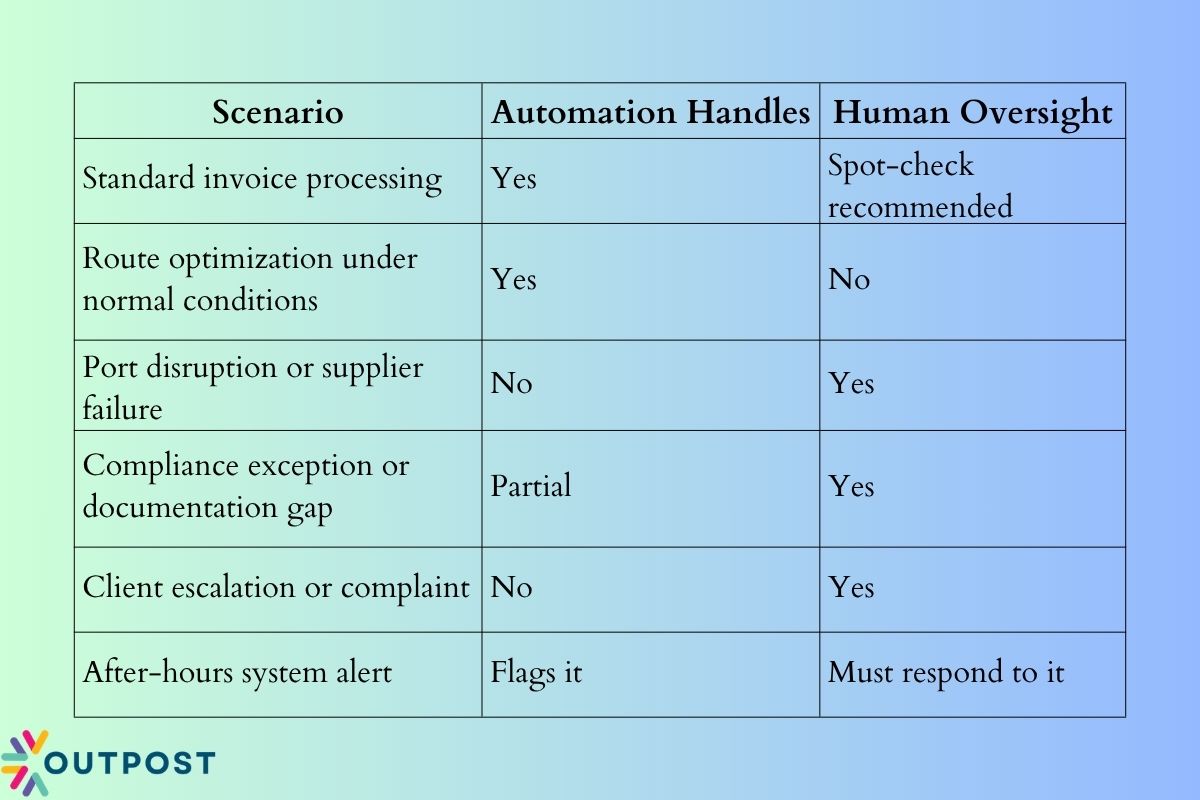
Automating processes works well for stable, predictable workflows. Candidates for automation in logistics typically include invoice processing, shipment status updates, and standard order fulfillment steps. These are repetitive tasks with clear rules and consistent inputs.
Complex processes are different. A sudden port closure. A supplier going silent mid-fulfillment. A vehicle breakdown during a night delivery.
These are not edge cases, they are regular occurrences in complex business environments. Automation offers no real answer when the rules no longer apply.
People do. Experienced operators can automate complex processes at the process design level, but they also need to be available when those designs hit the wall.
Human decision-makers weigh trade-offs, make calls, reroute shipments, and keep business runs on track when no algorithm can.
Here is where automation and human oversight split responsibilities clearly:
3. Automation Cannot Cover After-Hours Operations Alone
Global logistics runs 24 hours. Freight crosses time zones at night. Automation technologies monitor shipments continuously but monitoring and responding are two different things.
New automation tools can flag a delayed load at 2 AM. What they cannot do is call the driver, coordinate a reroute, update the client, and log the resolution before anyone else logs in. That requires a person.
Businesses that invest in technology to automate their monitoring but leave the response layer unstaffed are effectively letting alerts sit until morning.
After-hours human coverage is one of the most underused automation opportunities in logistics today. Companies that add this layer see faster resolution times, fewer escalations, and stronger client relationships. The automation runs the watch. The humans handle what it finds.
4. Compliance Needs Someone Accountable

Different types of business in logistics face overlapping regulatory environments such as customs rules, temperature chain requirements, weight and load restrictions, import permits.
Business process automation software can enforce compliance steps within a defined workflow.
But compliance is not just about following steps. It is about risk management. Regulations change. Jurisdictions vary.
An automated system may pass a process step based on last quarter’s rules while missing an update that took effect last month.
Identify processes where regulatory requirements shift frequently, and those are exactly the processes to automate with human review built in.
Accountability is the other side of this. When an automated decision causes a compliance failure, someone has to own it.
Human monitors provide that accountability layer like reviewing system outputs, authorizing exceptions, and ensuring that automation initiatives do not create gaps in responsibility.
5. Client Communication Is Still a Human Job
Automation can streamline routine notifications. Shipment confirmations, delivery ETAs, status updates, these work fine as automated messages when everything is on track.
When something goes wrong, clients do not want a system message. A client whose shipment is stuck at customs, or whose delivery window has shifted, wants a real person who can explain the situation and tell them what happens next.
Customer relationship management under pressure is genuinely relationship work.
Human agents with live access to logistics data can pull up a specific shipment, speak to the situation directly, and represent the company in a way that builds trust.
This applies across specific business types, freight forwarders, last-mile operators, third-party logistics (3PL) providers. The channel matters less than the fact that a person is on the other end of it.
6. Algorithms Drift and Bias Builds Up
Automation strategies built on historical data optimize for conditions that existed when the model was trained. When those conditions shift seasonal demand changes, new suppliers, updated routing costs, the system keeps running on old assumptions.
This is where analytics and regular human review become critical. Teams doing data analysis regularly catch drift early.
An algorithm that consistently scores one carrier lower without a clear performance reason, or demand forecasting that is running weeks behind actual purchase trends, these are the kinds of issues that surface through active human review, not through the automation itself.
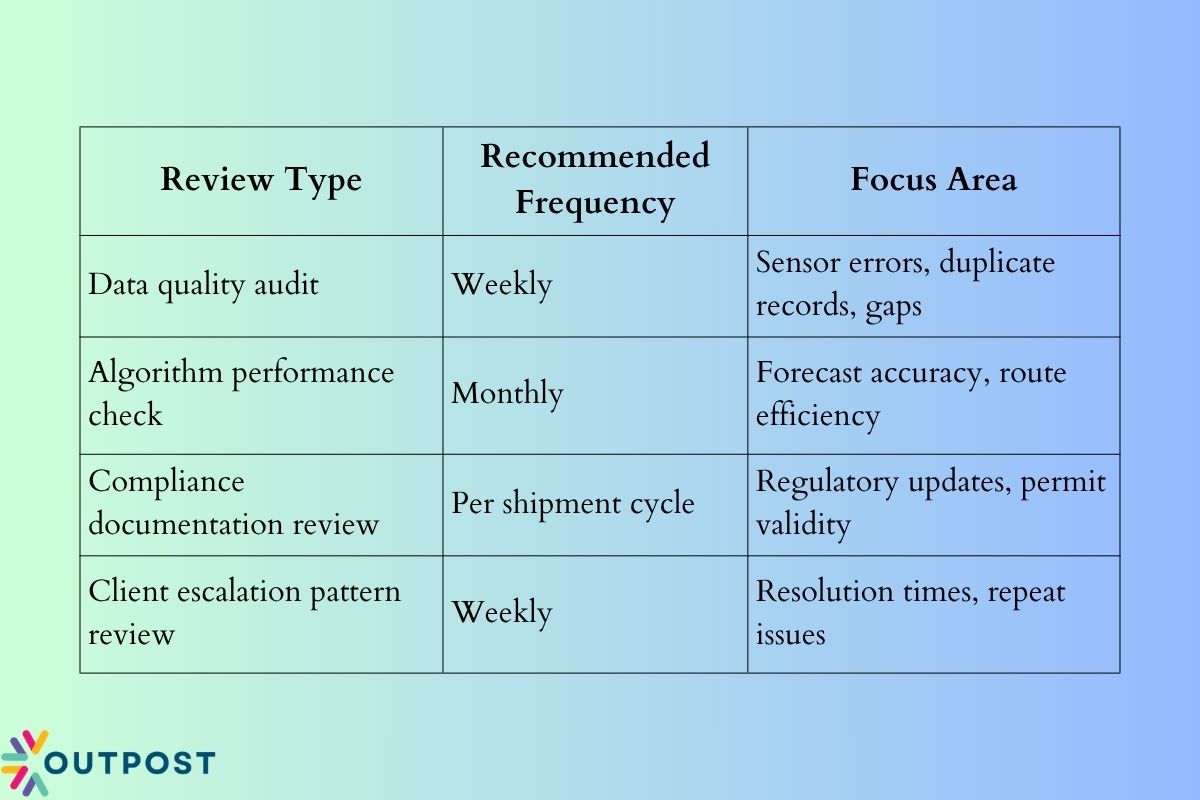
These review cycles are best practices that logistics teams should build into how they operate alongside their automation efforts.
Tools like Power BI make it easier to surface the right signals but someone still has to look at the data and act on it. Streamline these reviews into the existing operations calendar, and they become a natural part of how the business runs.
7. Continuous Improvement Requires Human Input
Automation helps logistics teams streamline operations, reduce manual processes, and improve efficiency across the board. But the automation does not improve itself. Someone has to watch how it performs, spot what is not working, and feed those observations back into the system.
A night-shift coordinator who notices that a specific route consistently triggers delay alerts. A warehouse supervisor who sees that robot picking recommendations create congestion in a particular zone.
A customer service agent who flags that one shipment type generates a disproportionate volume of client calls. These observations do not show up in automated reports. They come from people paying attention.
When those observations feed back into the process when automation developers adjust parameters, when management processes get updated, when the right processes get refined based on frontline input the automation gets genuinely stronger over time.
This is how growing your business with automation actually works. You implement, monitor, adjust, and improve.
Business automation solutions deliver their best results when they are treated as living systems that need human stewardship not software deployments that run on their own.
The benefits of business process automation are real: time-consuming manual processes get replaced, productivity improves, and teams can focus on higher-value work.
But those benefits depend on having people who actively maintain, review, and improve the automation over time.
Automating business processes is a smart move for any current business running logistics at scale. The automation handles the volume. The humans handle everything the automation cannot.
If your logistics business needs that human layer especially for after-hours coverage, client communication, and system monitoring support Outpost‘s outsourced call centre is built for exactly that. Real people, available when your automation runs but cannot respond.
Final Thoughts: The Human Safety Valve

Let’s be real, automation is a high-speed engine, but it lacks a steering wheel when the road gets messy.
Replacing manual processes with software is a massive win for productivity, but it shouldn’t mean leaving your business on autopilot in a storm.
The most resilient logistics operations aren’t the ones with the most robots but the ones that treat business automation as a partnership.
Use the tech to handle the grind, but keep human eyes on the “what ifs.” That’s how you keep your workflow bulletproof and your clients actually feeling heard.
About the Author: Tansi G