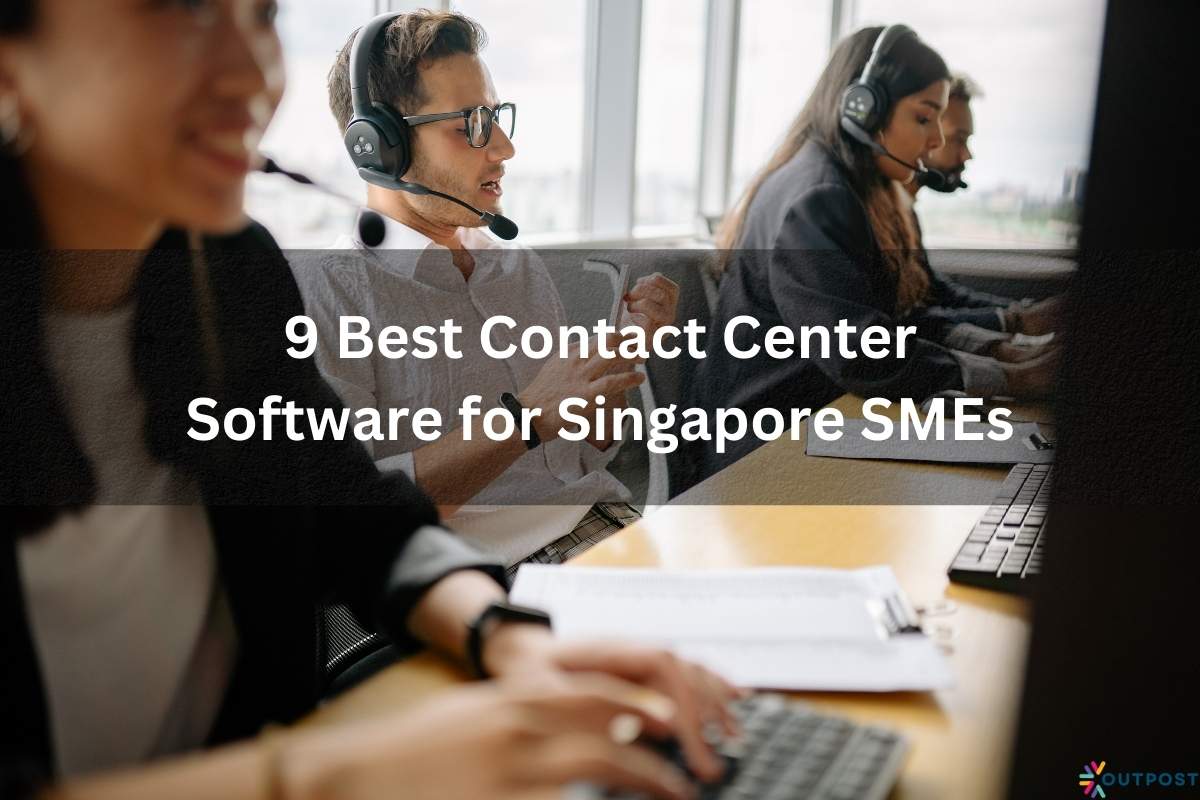
If your team is still juggling calls, WhatsApp messages, and email inquiries from three different screens, then it might be time to seriously look at a contact center software.
For many Singapore SMEs, customer communication has been steadily demanded while quietly becoming the most chaotic part of their operations.
Not because demand is low, but because it’s scattered.
If you’re looking to explore the different contact center solution that fits best for your business in Singapore, you’re in luck.
This guide breaks down the 9 best contact center software options for Singapore SMEs, which focus on omnichannel handling, customer relationship management (CRM) integration, reporting clarity, scalability, and practical deployment.
So, not to overwhelm you, we’ll focus on explaining which of the platforms makes the most sense depending on your team size, call volume, and operational maturity.
Because the truth is simple: software alone doesn’t fix missed calls.
It’s the right system that’s properly implemented with an expert team for customer support—like outsourced call handlers.
What is a Contact Center Software

Generally, a contact center software is a system that brings all your customer conversations into one organised place.
This means that instead of managing different contact channels from various devices, every customer engagement will be streamlined into one software. This includes:
- Phone calls from a desk phone
- WhatsApp messages on a mobile
- Email in Outlook
- Facebook messages in a browser tab
Through this contact center software, your team can handle all voice, chat, email, and even social media messages into one platform. Ensuring that they can track and report them together, thereby improving service quality.
These kinds of software don’t heavily rely on on-site hardware and fixed lines, unlike traditional call centre setups. This is because they operate on a cloud-based platform.
This means that agents can work remotely, while supervisors can monitor performance in real time. For businesses, having this call centre software means they can scale up or down without installing new infrastructure.
For SMEs with limited resources or manpower, this means that they don’t have to invest in physical spaces or hardware, and overstretch their in-house team.
Rather, they can streamline their operations; and if they have limited manpower, outsource call center professionals at lower costs but with wider coverage.
In fact, Singapore SMEs would greatly benefit from the call center software by addressing one urgent challenge that has been plaguing businesses: missed customer communication, which equals lost revenue.
Additionally, contact center software solves three core problems:
- Visibility – You can see every enquiry and its status.
- Accountability – Each interaction is assigned, tracked, and logged.
- Consistency – Responses follow a structured workflow instead of ad-hoc replies.
In short, investing in this software is not just about answering calls. It’s about building a system where no enquiry falls through the cracks—even during peak hours, staff leaves, or after-hours periods.
9 Contact Centre Software for Singapore SMEs
SMEs, nowadays, are increasingly turning to customer experience solutions to manage interactions across multiple channels.
One solution is the cloud-based, subscription-model contact centre software that is often known as the Contact Center as a Service (CCaaS).
This software enhances customer experience through modern call centre operations, dealing with inbound and outbound engagements.
To find the right call centre solution for your business, we listed the 9 best contact centre software for Singapore SMEs.

1. Genesys Cloud CX
As a leading AI-powered CCaaS, Genesys Cloud CX boasts their capabilities of personalising end-to-end experiences at scale in more than 100 countries.
Their services are aimed at enhancing customer loyalty and employee retention. Specifically, they offer:
- Omnichannel: Voice, Webchat, Email, SMS, Social (e.g. Facebook Messenger, WhatsApp) via Genesys APIs.
- AI and Automation: Natural-language chatbots, automated call distribution (ACD), speech analytics, agent-assist AI, and real-time transcriptions.
- Workforce Engagement: Workforce management (WFM), quality assurance (QA), call recording, interactive voice response (IVR), self-service, advanced reporting.
- Integrations: Pre-built connectors for Salesforce, Microsoft Teams/Office 365, ServiceNow, Zendesk, Slack, and more; open REST APIs for custom CRM or telephony.
Additionally, they support hundreds of agents; hence, they have a very high scalability range. Perfect for SMEs.
For Singapore SMEs, Genesys Cloud CX can be a great option as they offer local data residency. Particularly, the company stores and processes personal data through a Singapore-based data centre.
As for pricing, the company offers a range of plans, depending on the AI-powered service that you’ll avail:
- Genesys Cloud CX 1: US$75 per user per month
- Genesys Cloud CX 2: US$115 per user per month
- Genesys Cloud CX 3: US$155 per user per month
- Genesys Cloud CX 4: US$240 per user per month
2. Amazon Connect
Amazon Connect is a complete AI-powered solution geared at transforming customer interactions at scale.
The company boasts their capability of turning every customer touchpoint into a value-adding opportunity, such as 50% reduction in agent training time.
As for their key features, the promising services they offer include:
- Omnichannel (via integrations): Built-in voice and chat. SMS/WhatsApp can be added via Amazon Pinpoint or SNS. Many AWS partners offer WhatsApp integration.
- AI and Self-Service: Virtual agents via Amazon Lex (Chatbots), speech recognition, voice transcription, sentiment analysis (Amazon Transcribe & Comprehend).
- Routing and Analytics: Omnichannel routing, IVR, click-through rate (CTR), real-time dashboards. Integrates with AWS QuickSight/Kinesis for custom analytics.
- Global Infrastructure: Runs on AWS AP-SG (in use) with a full AWS compliance stack (GDPR, etc.).
For Singapore SMEs, this could be a great option. Not only does the setup require minimal costs, but it also has very flexible pricing with fast-to-scale capabilities.
Additionally, local data is easily controlled as it is stored and processed in the AWS SG region. Hence, the company is approved by the Monetary Authority of Singapore (MAS) and is compliant with the Personal Data Protection Commission (PDPC) Singapore.
For pricing, Amazon Connect offers a pay-as-you-go pricing plan, which means that its services aren’t quoted based on agent seats or peak capacity.
Rather, it depends on what your company only uses, making it a personalised service.
- Voice: US$0.038 per minute
- Chat: US$0.010 per message
- Messaging: US$0.014 per message
- Email: US$0.080 per email
- Outbound campaigns: US$0.045 per minute
- Tasks: US$0.070 per task
- Step-by-step guides: US$0.010 per message
The company also offers “a la carte” pricing where you can avail specific communication channels and features, without having to get all other services offered in their plans above.
3. Five9 Cloud Contact Center
Trusted and used by over 3,000 customers across the world, Five9 boasts their human-centred, AI-powered customer experience (CX) services with an 80% intent-matching accuracy through their AI agents.
Their dedicated CCaaS has deep industry solutions for healthcare, finance, and other sectors, which proves its reliability and its comprehensive CCaaS feature set.
In fact, their key features include:
- Omnichannel: Voice, email, chat, SMS, social messaging (including WhatsApp, LINE integration).
- AI and Analytics: AI agent assist, speech analytics, predictive dialer (ABCD), quality management, WEM and workforce optimisation.
- Cloud Reliability: Fully multi-tenant on AWS, with geo-redundancy and built-in disaster recovery.
- Integrations: Native connectors for Salesforce, MS Dynamics, Oracle, Zendesk, ServiceNow, Cisco, Avaya, and more via Open APIs. Social media integrations (Facebook, Twitter) and Messaging (LINE, WhatsApp) are supported.
While their data residency depends on the tenant region, the platform runs on Amazon cloud.
Nonetheless, Five9 highlights that they meet the security standards of the Payment Card Industry Data Security Standard (PCI DSS) and General Data Protection Regulation (GDPR).
However, for Singapore SMEs, they should use the Singapore region configuration to ensure compliance with MAS/PDPA guidelines, alongside ensuring PDPA obligations.
For pricing, Five9 can be considered to be relatively costly for SMEs. This is because their plans range from:
- Digital: US$119 per month per seat
- Core: US$159 per month per seat
- Plus, Pro, and Enterprise: to contact sales for flexible pricing
4. Talkdesk CX Cloud
Talkdesk offers modern, easy-to-use CCaaS through multi-agent orchestration—all supported by an intuitive surface and strong AI/UX innovation.
According to their clients, the company achieved a decreased abandonment rate by 5.3%, improved service level by 89%, and increased containment rate by 40%.
Their CX cloud capabilities include:
- Self-service: Intelligent customer self-service features for instant customer support and responses through voice and digital bots.
- Omnichannel Engagement: Standard plans include voice, email, chat, SMS, and social messaging (Facebook, Twitter, etc.). Professional tiers add more.
- AI and Automation: Talkdesk CXA (AI) for conversational AI, agent assist, transcription, sentiment. Autopilot virtual agents and Navigator intelligent routing modules are available.
- Reporting and WEM: Advanced analytics, workforce management (with Einstein Analytics in Salesforce or Talkdesk WFM as add-on), screen recording, quality management (Elite tier).
- Integrations: Out-of-box with Salesforce, Microsoft Teams, ServiceNow, Zendesk, HubSpot, and dozens of others (450+ integrations including Google Workspace, Slack, Zoom).
The company offers flexible SME-friendly packages, which makes it a good option for businesses specifically concerned about scalability.
As for local data and compliance, Talkdesk residency is not region-specific. So, while it’s PCI DSS and Health Insurance Portability and Accountability Act (HIPAA) capable, Singapore SMEs must still ensure their PDPA compliance via contractual agreements.
As for pricing, Talkdesk offers several packages depending on your needs, categorised between Talkdesk CX Cloud and Talkdesk CXA. For Talkdesk CX Cloud, the prices range from:
- Digital Essentials: US$85 per user per month
- Voice Essentials: US$105 per user per month
- Elite: US$165 per user per month
- Industry Experience Clouds: US$225 per user per month
5. Twilio Flex
For customer experience solutions catered to every stage of the customer journey, Flex offers a digital engagement centre that integrates channels.
The company’s focus on facilitating customer relationship management leads to high-touch, contextual direct sales.
In this regard, Flex is a highly customisable contact centre platform (programmable CCaaS). This makes it the best option for organisations with dev resources or specific requirements.
Flex’s key features includes:
- Programmability: Build any UI/workflow using Twilio APIs (Voice, Messaging, SMS, WhatsApp, Chat, TaskRouter).
- Omnichannel and Bots: Built-in support for voice, SMS, WhatsApp, chat, video; easy integration of Twilio Autopilot (chatbots).
- AI and Analytics: Use Twilio Media Streams + AI (Google/IBM/AWS) for transcription/sentiment; Flex Insights for dashboards.
- Integrations: Extensive integration system. Any system via API (Salesforce, Zendesk, custom CRM). Twilio CRM Connector and plugins exist.
Aside from this, its scalability is also very high. SMEs can start very small (even with a single agent) and then grow, as Twilio runs hundreds of thousands of concurrent channels.
Twilio Flex is a strong choice for tech-savvy SMEs or startups with development teams and custom channel workflows. However, it requires development effort that some businesses may not have the resources for.
For SMEs who don’t know yet if Flex is for them, the company interestingly offers a free trial, followed by per-hour pricing, and then per-user pricing.
- Free trial: 5,000 free active user hours
- Per-hour pricing: Starting at $1.00 per active user hour
- Per user pricing: Starting at $150 per named user
Interestingly, they also have additional features like Agent Copilot and flex mobile with flexible prices as well.
6. Zendesk
Zendesk is one of the leading cloud-based software-as-a-service (SaaS) companies, dedicated to customer service and engagement platforms.
They boast of catering, and being trusted by more than 100,000 companies, like Uber, Tesco, and Lush.
Known for their help desk ticketing as an AI-powered resolution platform, Zendesk Suite adds voice (Talk) for omnichannel customer service. This simplifies operations by bridging gaps between agents, systems, and channels.
As such, they are perfect for businesses with support-centric operations.
Their key features include:
- Channels: Core Suite provides email, chat, messaging apps. Talk adds inbound/outbound voice, IVR, voicemail. With Sunshine (Zendesk’s platform), you can integrate social messaging (e.g. WhatsApp, Facebook).
- Self-Service and Bots: Omnichannel ticketing, Help Center, Chatbots (via Answer Bot and Sunshine Conversations).
- Workflow and Reporting: Unified agent interface (Support+Talk tickets), built-in analytics, satisfaction surveys.
As for local data and compliance, Zendesk stores all information on their global datacentres.
Nonetheless, they are ISO/PCI certified, and offer “Advanced Data Privacy and Protection” add-on for businesses needing to meet unique security requirements.
SMEs with varying needs and budgets may look into Zendesk, as they offer several plans categorised between customer service and employee service. For customer service, their prices range from:
- Support Team: $19 per agent per month
- Suite Team (AI included): $55 per agent per month
- Suite Professional (AI included): $115 per agent per month
- Suite Enterprise (AI included): $169 per agent per month
- Interestingly, the company also offers several add-ons like:
- Zendesk Quality Assurance: $35 per agent per month
- Zendesk Workforce Management: $25 per agent per month
- Contact Center: $50 per agent per month
7. RingCentral Contact Center (RingCX)
RingCX is an AI-first contact centre which aims to streamline agent management for enhancing team performance and improving customer satisfaction, all within one omnichannel platform.
The company boasts serving over 500,000 businesses across the world, like eBay, Telus, and Reddit.
For SMEs, this could be a good option to consider as the company promotes an easy-to-deploy and easy-to-use contact centre, encompassing over 20 digital channels. This is supported by their “99.999% agent availability”.
Their key features include:
- Omnichannel: Voice, email, chat, SMS, social messaging (via add-ons). Includes ACD, IVR, queue callback, and predictive/preview dialers.
- AI and Analytics: Real-time reporting, call transcription (Summaries) in all plans, AI coaching (in higher tiers). Workforce management and QA in upper plans.
- Integrations: Native RingCentral Office integration (for phone); connectors for Salesforce, Zendesk, Microsoft Teams, Slack, and Google Workspace.
For Singapore SMEs, RingCentral complies with data privacy and protection (GDPR, ISO/PCI) guidelines within the Asia Pacific (APAC) region. Through their controls, Singapore’s privacy obligations can also be met,
However, RingCX’s pricing can be considered to be a bit higher than that of other platforms.
Nonetheless, they still offer a range of plans for various sizes of businesses. Non-discounted plans include:
- Standard: $75 per user per month
- Professional: $110 per user per month
- Elite: $165 per user per month
- Enterprise: contact RingCX for pricing.
Like other companies, they also offer add-ons, which makes their plans flexible depending on the particular needs of a business. This includes:
- AI Interaction Analytics: $25 per user per month
- AI Quality Management: $25 per user per month
- AI Workforce Management: $20 per user per month
8. Aircall
Aircall is a cloud phone system with call center features, tailored to SMEs. This offers easy setup and decent integrations but can be considered as less full-featured than enterprise CCaaS.
As such, they are best for voice-centric support (with SMS) rather than heavy contact center needs.
Considerably, their key features include:
- Voice and SMS: Inbound/outbound calls, IVR, call queues, recordings. Business SMS/MMS (US/Canada/UK only). Multi-currency credit top-up for outbound.
- AI Assist (add-on): Call transcription, summaries (Freely-available minutes) and analytics (if added). Basic CRM logging.
- Integration: 100+ apps (HubSpot, Salesforce, Zendesk, Shopify, Slack, Teams, Google, etc.). It even offers a WhatsApp integration.
- Global Numbers: Local phone numbers in 100+ countries, including Singapore. Supports BYOC (import numbers) and toll-free.
However, while Aircall is ISO/PCI certified, they have limited APAC presence. Hence, Singapore-local data are stored in their AWS servers in Australia or the US.
This company also has fewer contact centre features, which might not be the best for Singapore SMEs needing flexibility.
Nonetheless, aside from their custom pricing and various need-specific add-ons, their plans for annual billing have a 25% discount:
- Essentials: $30 per license per month
- Professional: $50 per license per month
- AI Assist (Add-on): $9 per license per month
- AI Assist Pro (Add-on): $49 per license per month
9. Freshcaller (Freshdesk Contact Center)
One of Freshworks’ customer support products is the AI-powered helpdesk software, Freshdesk.
It’s an affordable cloud-based contact centre geared for SMEs, as they provide voice call management.
The company boasts of being able to serve more than 74,000 people in over 120 countries, thereby saving 1.3 million hours of work.
Their key features include:
- Voice Channels: Inbound/outbound calling, IVR/phone trees, call queues, call recording, call transfer, IVR.
- Usage Modes: Supports various dialing (inbound, outbound, blended, preview).
- Integrations: Built-in with Freshdesk (helpdesk) and Freshservice. Marketplace apps for Salesforce, Zendesk, Teams, Slack, etc. API available.
- AI and Productivity: Basic analytics/dashboards, and “Freddy AI” for IVR voice bots in higher tiers.
- Other: VoIP/SIP trunking (bring your own carrier), or buy local numbers in 90+ countries.
As Freshdesk is intended for small to medium-sized teams (about 10 to 50 agents), its scalability is not the most flexible.
This means that while you can scale larger, you have to avail larger plans as their minute credits (2000 to 5000 per account) imply moderate usage.
Then, for local data and compliance, the company hosts its server in APAC. Hence, they are GDPR/PDPA compliant. Singapore-specific data can also be stored in the local region.
For Singapore SMEs, this option is good as they offer very low entry cost, which means that it’s perfect for those needing to set up a quick call centre. However, they have a basic feature set for their lower plans.
Their plans range from customer service, IT and employee services and CRM products. For Freshcaller:
- Free
- Growth: $15 per agent per month + pay per minute
- Pro: $39 per agent per month + pay per minute
- Enterprise: $69 per agent per month + pay per minute
Final Thoughts: Investing in the Contact Center Software in Singapore

When choosing the right contact centre software for Singapore SMEs, the question is not about their features.
It’s about how well they fit the needs of the business and how well they can complement your customer service operations.
The right platform should support omnichannel communication for better efficiency, integrate smoothly with your CRM, comply with PDPA requirements, and scale flexibly as your business grows.
However, software alone doesn’t guarantee a strong customer experience.
Even the most advanced cloud contact centre solution still requires trained agents, clear scripts, and consistent quality control.
Pairing a robust contact centre software with outsourced operational support can reduce overhead while maintaining professionalism.
Ultimately, the best contact centre software for Singapore SMEs is one that strengthens responsiveness, protects customer data, and improves operational efficiency without adding complexity to your operations.
It’s important that you choose a system that can grow with you.
About the Author: Tansi G