
Hospitality services are judged in real time.
From a missed WhatsApp message about late check-in, a slow response about a booking question, or even a complaint that gets passed between shifts, all of these can damage guest experience before they can even reach the front desk.
This makes customer service workflow very important for hospitality businesses, which is the structure behind how enquiries are received, routed, handled, escalated, and closed seamlessly.
In Singapore’s market, where service standards are high and the hotel sector is both large and competitive, hospitality businesses need a workflow that is fast, clear, yet still human.
For hospitality businesses, establishing an effective customer support structure is very important, but it can be hard to manage when their service teams are strained. That’s why outsourced customer support teams (like Outpost’s!) are available to aid businesses anywhere in the world.
With these in mind, this article provides the key details that hospitality businesses should know about a customer service structure that can make or break their customer relationship management.
What Customer Service Workflow Means in Hospitality
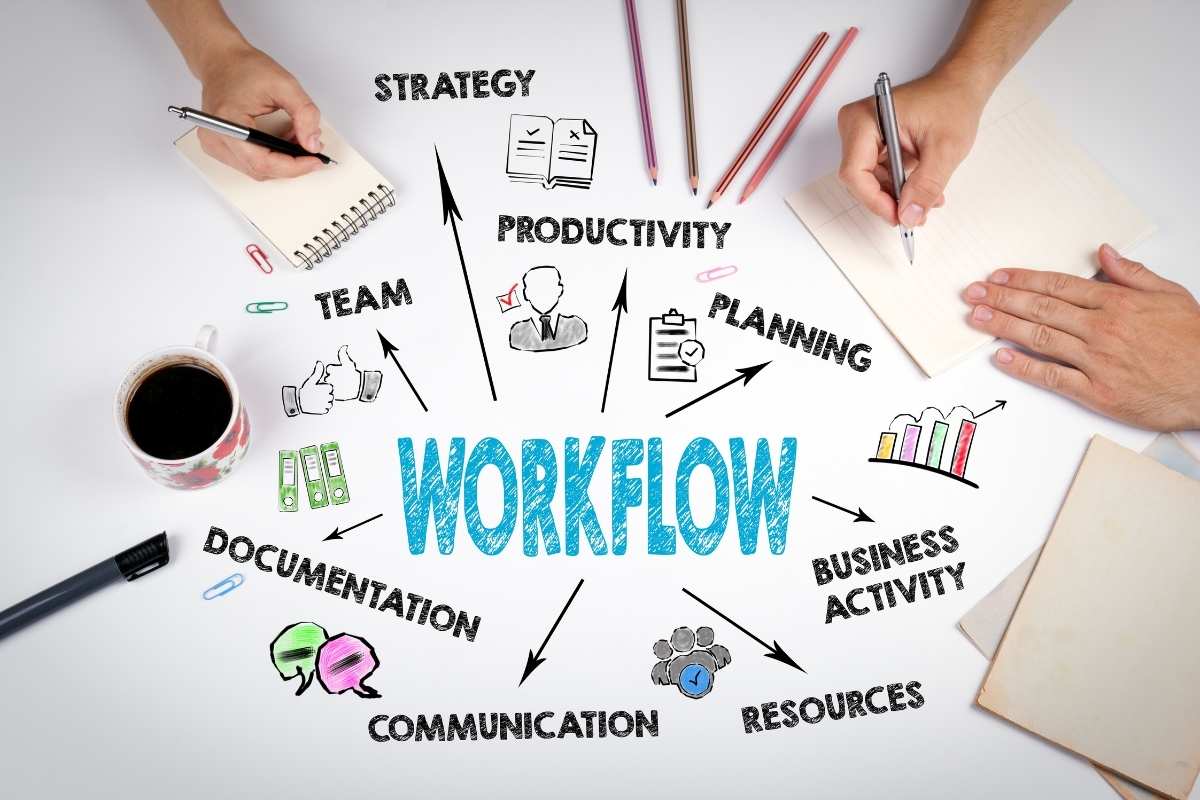
Customer service workflow refers to the process that a business uses to handle questions, requests, and problems from first contact to final resolution.
Salesforce described it as the system that defines:
- how requests are received
- who is responsible
- what tools are used
- when a case is considered resolved
In the hospitality industry, that process stretches across more touchpoints than many other industries.
For example, a guest may enquire through email, call the front desk, send a WhatsApp message, use web chat, or raise a concern during the stay. Sometimes, even on multiple platforms simultaneously.
This makes a seamless approach essential.
So, if those touchpoints are not connected by a clear workflow, the guest experiences the gaps immediately.
This matters because hospitality isn’t just about solving an issue. It’s proactive and relationship-driven, which is a bit different from customer service that’s often immediate and problem-focused.
In practice, that means hospitality businesses need both warmth and operational discipline to enhance the overall customer experience.
A hotel can have friendly staff, but if requests are delayed, routed to the wrong team, or lost between departments, the guest still experiences poor service.
This means that communication across teams and with guests improves operations and ultimately enhances customer satisfaction through effective CRM practices.
In essence, then, an effective customer support workflow isn’t a back-office technicality for hospitality businesses. It’s a crucial business strategy which affects guest trust, online reviews, repeat bookings, and staff efficiency.
When the workflow is clear, teams know:
- who owns each type of issue
- what qualifies as urgent
- when to escalate
- how to close the loop properly.
However, when it’s unclear, the guest ends up chasing updates, repeating information, or waiting for a response that should already have happened.
The Core Stages of a Hospitality Customer Service Workflow
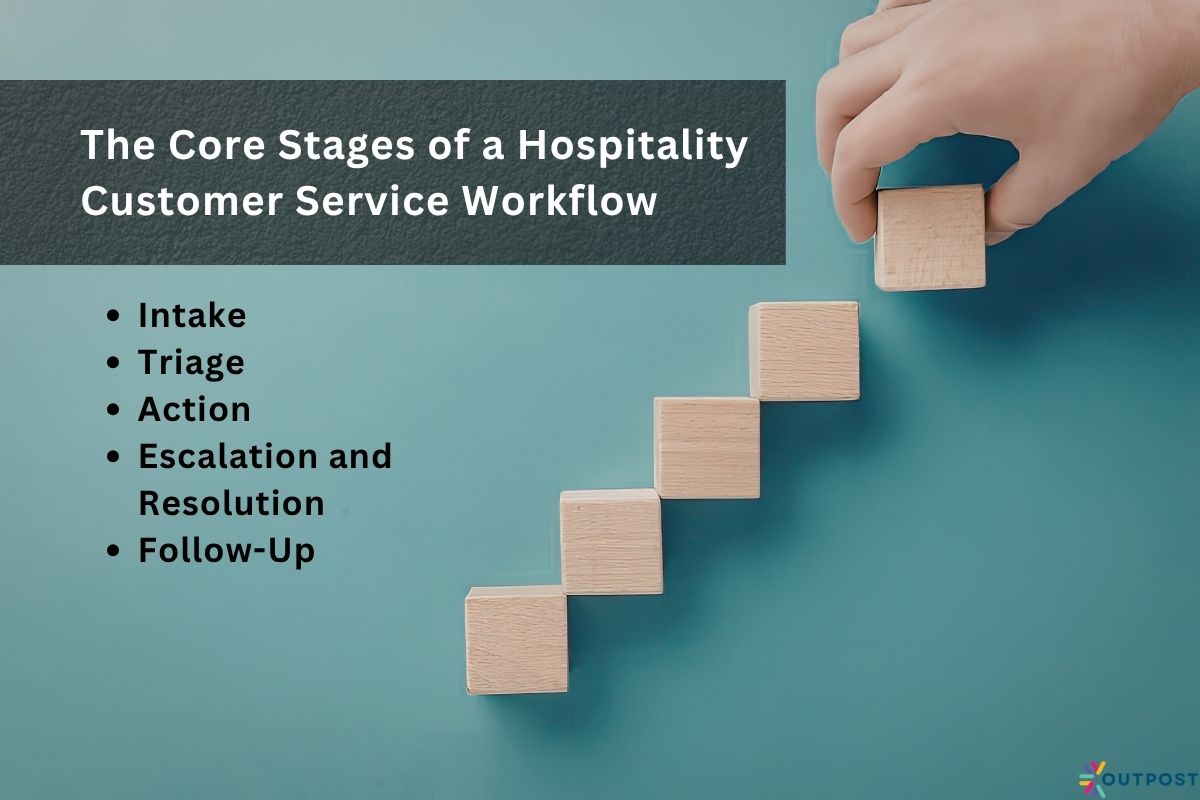
Creating customer service workflows that cover all aspects of the customer journey is essential to customer retention.
Thus, the most useful way to understand customer service workflow in hospitality is to break it into stages.
The process can be framed around five main stages, which make up a system model that fits the needs of hospitality businesses.
1. Intake
The first stage is intake, where guest requests enter the business’ communication platforms—such as through a phone call, email, web form, social channel, or messaging app.
In hospitality, intake happens:
- before arrival
- during the stay
- after departure.
For example, a guest may ask about airport transfers before check-in, request extra towels during the stay, or dispute a charge after checkout.
Because hospitality businesses operate across many channels, intake needs to be centralised enough that staff can see what has already been said and what still needs action.
In essence, centralised information and real-time access to reservations, requests, and room status promote smoother communication at this stage.
2. Triage
Triage is the second stage, which refers to the process of sorting out requests by urgency, complexity, and ownership.
Particularly, it’s the point of the system where customer enquiries are categorised and routed to the right person or team.
This is because not every request has the same urgency. For example, a general enquiry about parking is different from a message saying a guest is locked out of a room or upset about a billing issue.
Having a good triage reduces delays in response and avoids wasting managers’ time on matters that frontline staff can resolve directly.
It also stops genuinely urgent matters from sitting in the same queue as routine questions, which saves time for both customers and agents.
3. Action
The stage where the team handles the request using the right information, standard operating procedures (SOPs), and system access is the action stage.
For hospitality businesses, this involves close coordination across different departments, like the front office, housekeeping, maintenance, reservations, or finance.
This essentially means that all aspects of a request or concern are addressed through a collaborative action between teams.
Additionally, this stage reflects how well the different departments of a hotel operate in a harmonious function, because the guest experiences the property as one brand rather than a series of separate teams.
4. Escalation and Resolution
The fourth stage is escalation and resolution.
While some requests can be solved immediately, others need a:
- Manager
- Duty officer
- Maintenance technician
- Specialist team
As such, an escalation workflow is crucial for addressing issues that require immediate attention.
In the current modernised state of the industry, artificial intelligence (AI) has been increasingly adopted. Hence, automation has been used to resolve routine tasks or predictable enquiries.
But for complex or emotionally charged situations, escalation to a customer service representative with full insight is very important for resolving customer issues.
This is especially true for complaints, exceptions, compensation decisions, or any situation where reassurance matters as much as the answer itself.
Once the matter is resolved, the workflow should record what happened and confirm closure with the guest through an efficient ticketing system or reporting system. This ensures that all issues that require follow-up are documented.
5. Follow-Up
Follow-up is technically more of an additional stage if a situation calls for it.
Meaning, not all situations would need the support team to follow up on a customer. This is more applicable for complex and time-sensitive concerns.
Following up on a request or issue is worth going over to ensure that the guest is satisfied till the actual resolution of their needs, thereby minimising customer frustration.
Additionally, this step usually involves the review and update of customer support tickets to ensure that there are no backlogs or unaddressed messages from the guests.
Where Customer Service Workflow Usually Breaks Down in Hospitality
Customer service workflow usually breaks down at handoff points.
Channel Fragmentation
The first weak point is channel fragmentation.
A guest might message on WhatsApp, then call later, only to find that the staff member answering has no visibility of the earlier conversation, which brings the conversation back to square one.
Customer history can then provide additional information that would help create a seamless customer experience and even exceed customer expectations.
Ultimately, poor self-service and handoff create repeated customer interactions and extra frustration. This is why real-time access to guest data and conversation history enables the team to be aligned and up-to-date.
Unclear Ownership
The second weak point is unclear ownership.
A guest may get bounced around different teams and agents if nobody knows who is responsible for handling late-night complaints or after-hours enquiries.
As such, the best customer service workflow is one that clearly defines the roles, decision points, and escalation paths.
In hospitality, this becomes more important as different departments may constantly overlap.
Timing
The third weak point is timing.
Hospitality services don’t stop at 6 PM, nor do enquiries stop at working hours.
Guests will continue to call, message, complain, and request for help even after office hours. This, of course, reflects an increasing pressure for businesses to be reachable beyond normal operating hours.
This is because in the hospitality industry, slow responses can cost revenue, trigger complaints, and create reputational problems—all of which are crucial for a service-based, time-sensitive business.
How to Improve Customer Service Workflow Without Losing the Human Touch
Improving hospitality businesses’ customer service workflow doesn’t mean making service robotic.
It means making it easier for people to deliver good service consistently at scale, which is critical for enhancing the overall customer experience.
To help hospitality businesses, here are three key steps in improving customer service workflow that will help the support staff deliver exceptional customer experiences.
First step: clearly documenting workflow
Teams should know:
- which channels are monitored
- what counts as urgent
- who owns each customer request category
- when escalation is required.
This means that a good workflow improves response times, consistency, and onboarding because they remove ambiguity about what happens next and who should make the decision.
Second step: use technology to support people
Technology should be used to support people, not replace them.
Regardless of how good a technology is, it can never replace the human aspect that is the foundation of hospitality businesses.
As such, it’s important to choose the right supportive digital tools that can streamline operations, centralise information, and reduce bottlenecks.
Likewise, it’s important to understand that virtual agents and self-service work best when they complete routine tasks or hand off cleanly to humans with full context.
This means that businesses should find ways to efficiently automate the process to effectively address real-time customer complaints and customer needs, while also having a customer support agent to handle more complex support cases that will prevent customer frustration.
For example, AI can focus on addressing frequently asked questions, while human customer support agents can focus on more pressing support tasks, like addressing complex customer complaints.
Doing so can ensure the fulfilment of customer support needs, which could boost customer experience.
In other words, automation is most useful when it removes repetitive work, not when it traps guests in loops.
Third step: protect human moments
Hospitality is full of situations where tone, empathy, and judgment matter.
While a simple reservation amendment can be automated, a complaint about a ruined anniversary stay should not be handled like a standard ticket, as it requires a tailored approach to customer issues.
This is because in hospitality, every conversation and action leaves an emotional imprint.
That’s precisely why human support must remain as the foundation, even as workflows become more structured and digital.
In fact, when gathering feedback from guests, it’s almost always how well the human staff made them feel that gets shared within these spaces.
How Outsourced Teams Can Support Customer Service Workflow After Hours
One of the most practical ways to strengthen customer service workflow is to extend support without overloading the in-house team.
This is where outsourced teams can help, especially after hours operations.
For hospitality businesses, outsourced support can sit inside the workflow rather than outside it. The outsourced team can:
- Monitor incoming calls and messages
- Handle routine enquiries
- Triage urgency
- Log requests properly
- Escalate only the issues that truly need on-site staff or management attention
That’s especially useful for late-night booking enquiries, arrival coordination, simple guest questions, and first-line customer interactions handling to ensure quick issue resolution.
Additionally, outsourced teams can provide backup continuity, flexible scaling, and structured escalation.
These are all relevant to hospitality businesses trying to maintain response quality without staffing every hour internally, while integrating an effective customer service workflow.
A concrete example of this support model is Outpost. Its services include:
- handling customer enquiries through calls and WhatsApp,
- flexible coverage from single-agent support to after-hours and 24/7 managed customer service teams.
Ultimately, the key point is that outsourcing should support service standards, not dilute them.
If the external team is trained on brand tone, SOPs, escalation rules, and property-specific information, they can be a reliable extension of the business.
That gives hospitality operators a more sustainable way to maintain responsiveness—especially during evenings, weekends, and busy seasons—thereby enhancing customer satisfaction.
Customer Service Workflow Tips for Hospitality Businesses in Singapore
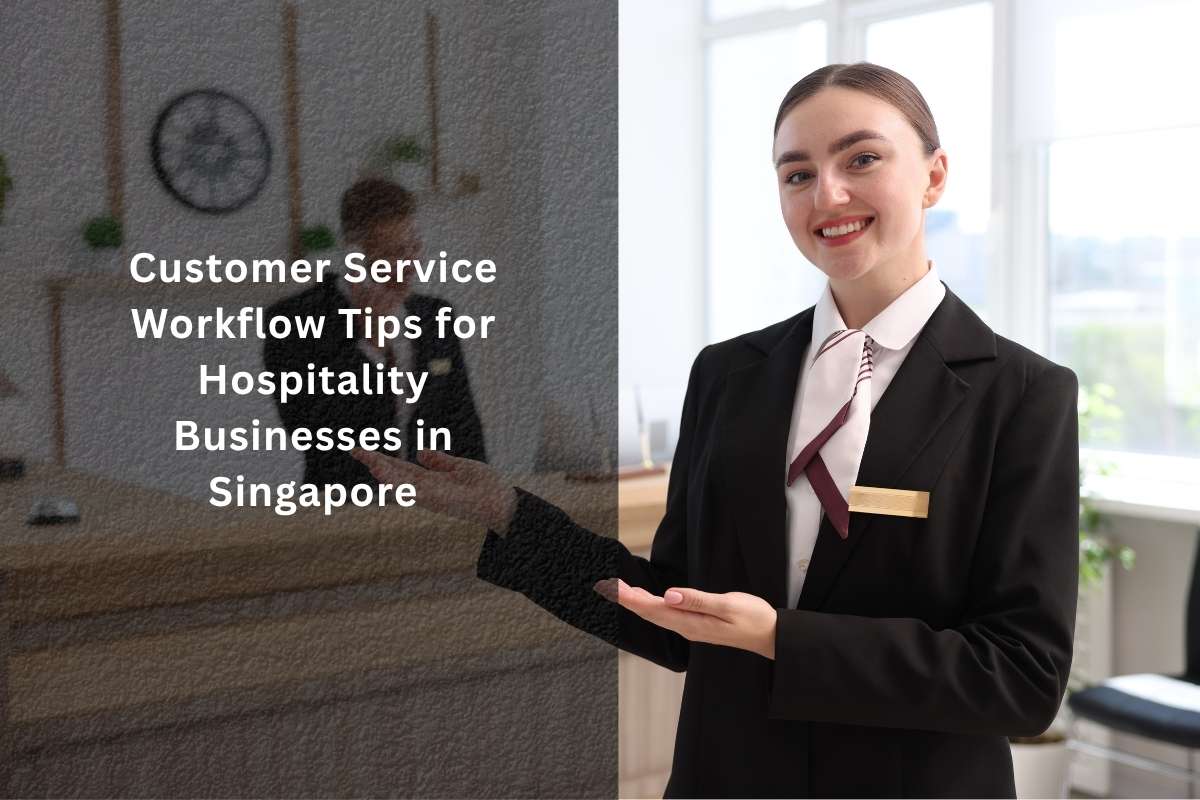
For hospitality businesses in Singapore, customer service workflow needs to reflect a market that’s digitally connected, operationally demanding, and highly service-conscious.
This is because they must focus on capability development and innovation.
That means response quality isn’t just a service issue: it’s part of operational competitiveness.
In practice, that means three things.
First, map the workflow across the channels that guests actually use, not just the ones the business prefers.
Second, build escalation paths for after-hours situations because customer requests don’t follow standard operational timings, which can affect resolution time.
Third, keep a hybrid model in mind. While customers expect fast, flexible, cross-channel help, they also need clean human escalation when self-service doesn’t resolve the issue.
For hospitality businesses, that could mean using automation for simple confirmations while relying on trained service agents to focus on sensitive, urgent, or high-value interactions—whether they’re in-house or outsourced.
Having this kind of customer support structure can help businesses ensure that issues are resolved and the customer is satisfied.
Final Thoughts: Support Workflow Influences Customer Experience
A strong customer service workflow helps hospitality businesses deliver what guests actually remember: quick replies, clear ownership, smooth handoffs, and confident problem-solving.
The best workflow isn’t the most automated one. It’s the one that combines structure with empathy.
For hospitality businesses in Singapore, that often means using better systems for workflow stages while keeping real people from the customer service team involved, where service quality depends on judgment and care.
Outsourced after-hours support can fit neatly into that model when it’s designed to extend the workflow, not complicate it.
About the Author: Tansi G