

AI customer service has shifted from a business experiment to an everyday essential business tool.
Globally, hospitality businesses are under immense pressure to reply faster than ever. Customers expect quick answers on different platforms: from website chats, WhatsApp, email, to even social media platforms.
This pressure comes from the demand of talking with a business representative before they make decisions, like before they book, while they are on the move, or late at night after they check-in.
In Singapore, this demand is even more apparent as the tourism sector actively prepares for broader AI adoption, while hotels must continue exploring digital concierge, check-in, and other service technologies.
However, hospitality is not like many other industries because it heavily relies on personal connections to provide customer service offers effectively.
More than just fast replies, customers want reassurance, warmth, judgment, and help when something goes wrong, which service reps strive to provide.
This means that while automation can improve efficiency, the hospitality industry still heavily depends on trust, emotional connection, and human touch.
For businesses with smaller teams, an outsourced customer service (like Outpost’s!) is perfect to be paired with system automations.
So, if you’re a hospitality business looking to adopt artificial intelligence (AI) in your support operations, you should focus on determining where AI should lead and where people should step in.
What Hospitality Businesses Should Know About AI Customer Service
AI customer service in the hospitality industry usually involves chatbots, AI concierges, self-service booking support, and agent-assist tools to handle large volumes of customer inquiries.
Generally, these tools commonly help in handling requests, surfacing information quickly, and reducing repetitive work.
As such, they are typically adopted to help staff answer faster and accommodate more people in a short amount of time.
This is because AI systems can streamline customer engagement, and AI can suggest customer insights based on customer data and past interactions, regardless of the volumes of customer inquiries.
In this sense, AI-powered customer service tools can help hospitality businesses to address customer needs, customer questions, and customer expectations—all with a personalised support approach.
However, it’s important to understand that for these technological tools to work best, they have to be integrated within a broader service system.
Particularly one that includes clear workflows, accurate information, and human escalation when the conversation becomes sensitive or complicated.
All these commonly occur in hospitality contexts, allowing teams to better respond to customer needs.
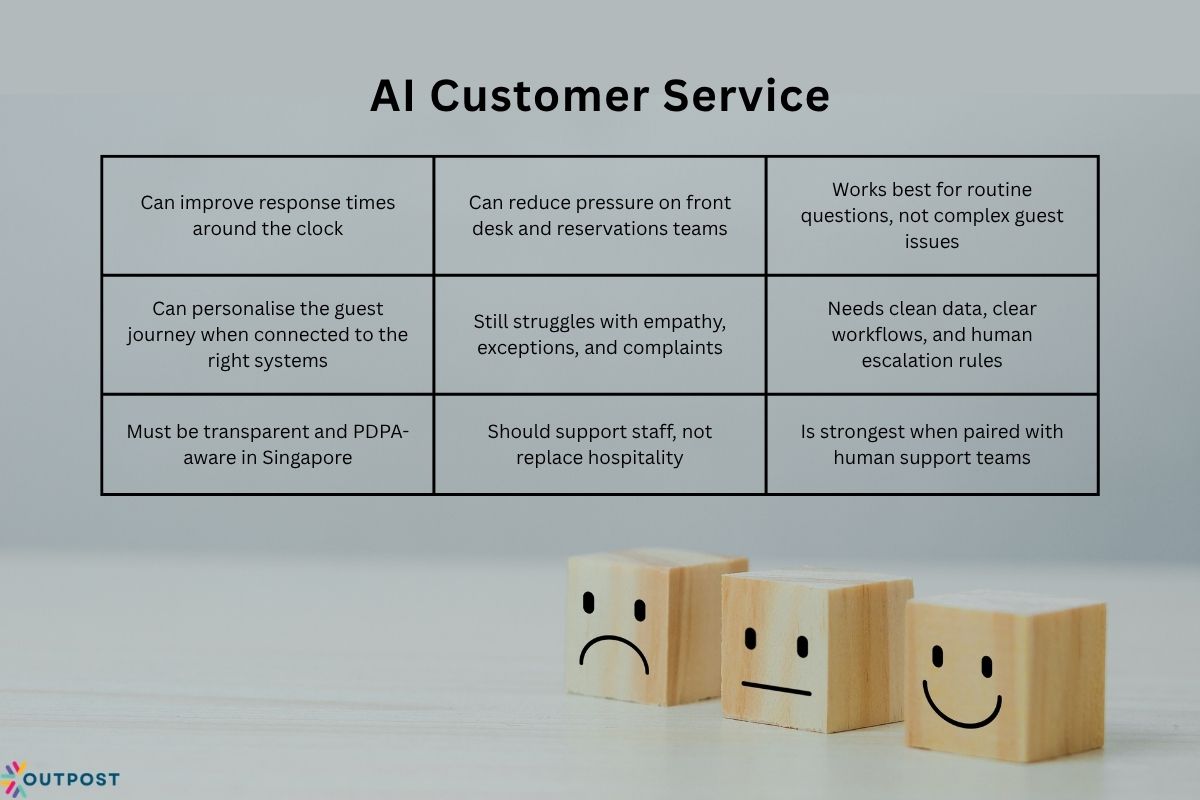
1. AI in customer service can improve response times around the clock
The clearest advantage to use AI in customer service is speed, which can help transform customer interactions.
Chatbots and AI agents, for example, don’t need to clock in during office hours to answer simple questions about:
- check-in time
- airport transfers
- breakfast hours
- parking
- late checkout policies.
Rather, they can provide 24/7 coverage for common questions or requests, thereby enhancing customer service.
This is particularly beneficial for hospitality brands that serve international travellers whose enquiries often come across time zones.
That’s why Singapore hotels and tourism operators are already leaning into this reality as part of a wider push towards modernising guest-facing operations.
Ultimately, this is where the benefits of AI in customer support really become genuinely useful for hospitality businesses.
If a guest only needs a quick answer or a short update, an instant service is better than making the guests wait for a human reply the next morning.
When used well, AI customer service can help reduce missed enquiries, which will show the guests that the business is responsive and organised.
2. AI in customer service can reduce pressure on front desk and reservations teams
Hospitality customer service teams often spend a lot of time answering the same questions over and over again.
AI for customer service can take that load off by handling simple yet repetitive enquiries, before they even reach the front desk, reservations desk, or concierge.
Human support agents then have more time for more complex and important tasks for customer needs, like
- in-person service
- operational coordination
- parts of hospitality that actually build loyalty.
One example in Singapore is Andaz Singapore, which utilises AI algorithms to enhance guest experiences. They designed their digital concierge to answer everyday customer inquiries, with the goal of improving manpower productivity while enhancing customer experience.
Thus, in the industry, the best use of AI is to remove low-value repetition so people can focus on higher-value service that will improve customer satisfaction.
3. AI customer service works best for routine questions, not complex guest issues
AI customer service performs best when the question is common, predictable, and easy to map. This allows teams to predict customer needs more efficiently.
Common structured service inquiries are best for AI, which include:
- “What time is the check-in and check-out?”
- “What time is breakfast?”
- “Can I store luggage?”
- “How do I get from Changi Airport to the hotel?”
- “Do you have connecting rooms?”
This is because businesses can only train AI models with commonly received questions to provide support around the clock.
While this may not be ideal for more complex situations, the future of AI in customer service is to effectively manage high support volumes, regardless of business hours.
However, when the guest’s issues become messy, AI can no longer serve its purpose.
For example, a booking error, double charge, service complaint, refund request, noisy room, accessibility need, or emotionally upset traveller rarely fits neatly into a scripted flow.
This means that while AI can still respond to such complicated customer messages, it can only do so much to actually address and satisfy customer expectations.
Furthermore, hospitality research has noted that AI adoption depends on more than functionality because guests still judge service through trust, emotional comfort, personal connection, and the effectiveness of AI customer service solutions.
In other words, efficiency from AI technologies helps, but human judgment still matters in a proactive customer service.
4. AI customer service can personalise the guest journey when connected to the right systems
Another one of the advantages of AI that hospitality companies are banking on is personalisation, which can transform customer experiences.
If the system is connected to booking data, CRM records, and property information, it can:
- recommend dining options
- suggest local attractions
- remind guests about add-ons
- route them to the right services faster.
This can make guests’ stay feel smoother and more tailored, which could improve customer satisfaction.
With that, you may be wondering why should we consider AI algorithms in customer service?
Because such personalisation helps the business extend service beyond the front desk and helps resolve issues with a more empathetic approach.
For hospitality businesses in Singapore, that matters a lot because local knowledge is part of the guest experience, therefore enhancing customer relationships rather than being a side detail.
Since customer service is transforming, especially with the integration of AI chatbots and other technologies, AI performance must adapt to real-world customer needs.
However, the high variation of customer service issues demands more than what digital technologies can do. Thus, AI alone can’t provide or analyse customer sentiment.
5. AI customer service still struggles with empathy, exceptions, and complaints
Many articles downplay the “human” capabilities of AI. While automated customer service can sound polished, it can still give a poor service experience.
In fact, Singapore consumers are already showing signs of frustration with automated support.
A recent study reported low satisfaction with AI-powered service. Common complaints included AI not understanding customer queries, giving generic replies, and sounding robotic.
The same study also found that nearly half of Singaporean respondents still prefer a human agent, even if it meant a slower response.
For hospitality companies, these findings matter even more, as tone and service recovery can directly affect reviews, repeat stays, and word of mouth.
This is because the fulfilment of customer requests and understanding of customer sentiment ultimately reflect the quality of customer service experience.
To give an example, a guest complaining about a ruined anniversary dinner or a bad room experience doesn’t want a chatbot looping through templated sympathy.
They want someone who can understand context, make a judgment call, and take ownership. All of which AI can’t offer the way humans can.
6. AI customer service needs clean data, clear workflows, and human escalation rules
AI is only as good as the information and rules behind it.
If the AI is fed inaccurate or incomplete information, then its responses will not be effective as well. This can happen if:
- The hotel’s room policies are outdated
- The WhatsApp bot doesn’t know what to do with a payment dispute
- The business has no clear handoff process
In this sense, automation can create confusion rather than save time. That is why AI customer service should never be treated as a plug-and-play fix.
Alternatively, the strongest setup for an AI customer service includes clear escalation triggers.
For example, a guest asking for directions can stay with AI. A guest reporting a safety concern, billing issue, missed airport pickup, or failed special request should be moved quickly to a support agent.
This hybrid approach is also the logic behind using customer insights to enhance service delivery. Thus, outsourced customer support models, such as Outpost’s, are very beneficial for companies with small customer service teams.
Outsourced support agents emphasise escalation rules, tone alignment, dedicated management, recorded interactions, and after-hours coverage instead of leaving everything to AI alone.
7. AI customer service in Singapore must be transparent and PDPA-aware
Hospitality businesses deal with personal data all the time:
- Names
- Phone numbers
- Passport details
- Booking histories
- Payment-related information
- Sensitive travel context.
If AI tools are involved in handling or analysing that information, governance matters.
This is because Singapore’s Personal Data Protection Commission (PDPC) issued advisory guidelines in March 2024 to clarify how the Personal Data Protection Act (PDPA) applies to AI recommendation and decision systems, alongside provide guidance on consent, transparency, procurement, and data protection practices.
For hospitality companies, this means that AI customer service can’t just be fast. It has to be trustworthy and credible, especially when enhancing customer service.
Ultimately, trust is part of the overall customer experience in hospitality.
So, guests shouldn’t be wondering how their data is being used. Customer support teams should know when automation is appropriate and when a human review is safer to resolve complex customer issues.
8. AI customer service should support staff, not replace hospitality
There is a clear difference between making service more efficient and making service feel less human.
If a hospitality business adopts AI mainly as a headcount-cutting exercise, it risks weakening the very thing guests remember: the quality of human service.
This means that while a fast reply has value, so does empathy from a real person who can:
- read the room
- calm a frustrated guest
- turn a bad moment around
All of which demands the touch that only human support can give.
That’s why the better approach is that AI should handle the repetitive parts of service, while people handle the moments that carry emotional weight or business risk.
Hospitality businesses shouldn’t treat the human team as a backup plan.
It should be the part that protects customer satisfaction when the interaction becomes more than a simple request, thereby responding to customer needs effectively.
9. AI customer service is strongest when paired with human support teams
The most practical business model for most hospitality businesses is a blended one.
AI should manage:
- first-line FAQs
- after-hours triage
- high-volume routine requests.
The human agents should then:
- take over calls
- escalations
- complaints
- booking issues
- guests who simply want to speak to a person.
This gives the business speed without sacrificing judgment, particularly in addressing customer issues.
This is also where outsourced teams become relevant.
Providers like Outpost are built around flexible human coverage across calls and WhatsApp, with options for:
- after-hours support
- multilingual service
- dedicated oversight
- quality-checked interactions.
For hospitality businesses that don’t want to build a full in-house customer service team, that kind of outsourced human layer can be supported by AI and take over the conversations that matter most.
Final Thoughts: Implementing AI in customer service needs human support
AI customer service has real value in hospitality.
AI can help businesses improve response times, reduce repetitive work, and make simple customer interactions easier to manage at scale.
But hospitality is still a people business. Guests remember how a business made them feel and how a team supported them, especially when something went wrong.
That is where human agents still matter most.
So the real takeaway is not that hospitality businesses should resist AI. It’s that they should use it carefully.
Let AI handle speed and volume. Let human teams handle nuance, empathy, and recovery.
In most cases, that’s the setup that gives guests the best experience and enhances customer relationships while balancing efficiency and service quality.
About the Author: Tansi G