

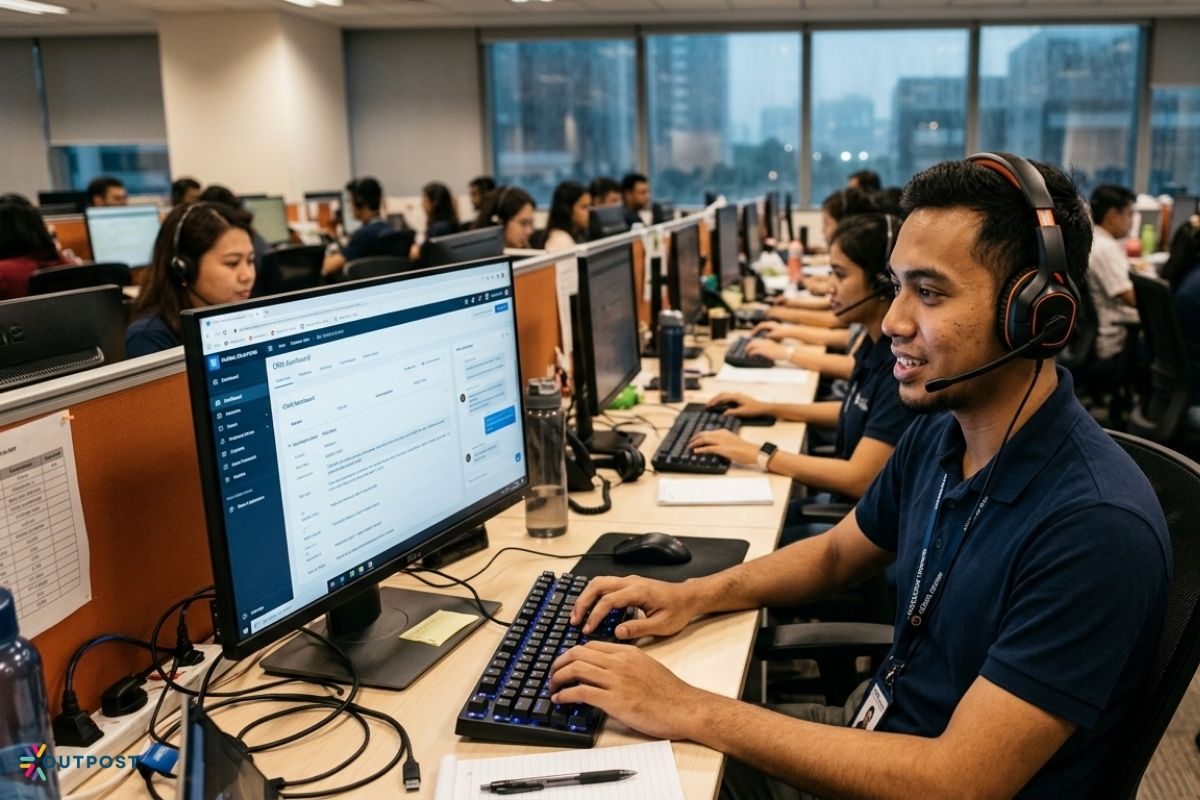
In e-commerce, one delayed customer response can mean a lost cart, a refund request, or a damaged brand reputation.
As online shopping becomes a 24/7 global activity, businesses increasingly rely on unified communications to enhance customer engagement.
Firms are now utilising softphones and outsourced teams to maintain always-on customer coverage without inflating internal costs.
Additionally, companies can leverage advanced softphone features that allow agents for seamless dial connections.
These allow brands to support customers across time zones, handle after-hours inquiries, and scale operations during peak periods using a reliable contact center and softphone provider, enhancing overall productivity.
In this article, we explore how softphone technology, combined with outsourced support teams, enables e-commerce businesses, to deliver seamless, round-the-clock customer service.
How does a softphone app work?
A softphone is a software-based phone system that allows customer service agents to make and receive calls over the internet, instead of traditional telephone lines.
Think of apps like Zoom and Dialpad, a softphone acts as a telephone interface on a desktop or mobile device.
It typically runs on laptops, desktops, or mobile devices and is integrated with cloud communication platforms and customer relationship management (CRM) systems.
What are the benefits of using a softphone for E-Commerce Support?
In e-commerce customer support, softphones are essential because they transform how service teams operate:
First, they enable agents to use a dialer that integrates with their existing systems for efficient communication and modern softphone solutions.
Location-independent support is enhanced through the use of a VOIP provider, allowing teams to make VoIP calls from anywhere.
Meaning, agents can work remotely or from outsourced service hubs while maintaining full call functionality through a VoIP provider headset that facilitates easy dial options.
This is particularly useful for distributed customer service teams serving global customers.
Second, softphones improve productivity by enabling seamless communication across various devices, including iOS and Linux platforms.
Integrate with digital systems to streamline the dial process and enhance customer interactions, such as order management platforms and helpdesk tools, including the best softphone for seamless integration.
This allows agents to instantly view customer purchase history, delivery status, and previous interactions during a call, improving resolution speed and accuracy for incoming calls.
Third, they support desktop applications and mobile apps that streamline communication processes, including unified communications as a service.
Scalability can be enhanced by integrating dial features into existing systems.
Unlike traditional call centers that require fixed infrastructure, softphone systems allow businesses to quickly onboard outsourced agents during peak periods without major hardware investment.
For e-commerce businesses dealing with fluctuating demand, softphones provide the flexibility needed to maintain consistent service quality and streamline operations.
Why E-Commerce Brands Use Softphone Solutions for 24/7 Customer Coverage

E-commerce operates using a mobile app and a softphone for business to enhance customer experience and streamline transactions.
This support is available beyond business hours for incoming calls.
Customers browse and shop late at night, across weekends, and often from different time zones. This creates a strong demand for continuous customer support, which is difficult and costly to maintain internally.
Softphone solutions enable 24/7 coverage in several key ways, including improved business communication.
One major driver is after-hours demand management can be streamlined through the use of voip phone systems for continuous customer support..
Customers frequently need support outside standard office hours, for example, tracking deliveries, modifying orders, or resolving payment issues, which can be easily addressed with a quick dial feature.
Without coverage, businesses risk losing sales or facing negative reviews, highlighting the importance of reliable softphone features.
Another reason is to look for a softphone that enhances communication efficiency and global market reach through the dial of a softphone.
Even Singapore-based e-commerce brands often sell across Southeast Asia and beyond using softphone services that enable easy international dial capabilities.
A customer in another time zone expects immediate support through call forwarding, not next-day responses, especially when using VOIP service providers.
Softphones also help during peak softphone work periods.
High-traffic sales periods can be effectively managed with the help of VoIP softphone technology and team messaging tools.
Events like 9.9, 11.11, and Black Friday are high-traffic sales periods that require effective business communication strategies, particularly through desktop and mobile softphone applications.
During these periods, inquiry volumes can spike dramatically, and outsourced teams using softphone software can scale up quickly to absorb demand for voice over internet protocol services.
Finally, brands use softphone-enabled support to enhance customer interactions and streamline their operations.
Also, this reduces intangible operational costs by implementing a softphone for business that streamlines communication.
Instead of maintaining multiple in-house shifts, businesses outsource after-hours coverage to specialized providers, achieving efficiency without sacrificing customer experience, especially through a VoIP system.
How Outsourced Teams Use Softphone Technology to Deliver After-Hours Support
Outsourced customer support teams rely heavily on softphone systems to deliver seamless after-hours service for e-commerce businesses.
One key function is the integration of VoIP services to enhance communication efficiency across various operating systems.
This supports shift-based global coverage with a reliable VoIP service that ensures seamless communication.
Outsourced teams are often distributed across different regions, allowing for effective call quality management during peak times.
For follow-the-sun support models, where one team hands over to another as the day progresses, it can be facilitated through the use of a softphone interface and cloud phone system.
Softphones ensure continuity of communication regardless of location, whether using an iOS or Android device or a desk phone, allowing users to make VoIP calls seamlessly.
Another critical capability is the ability to manage call transfers efficiently. intelligent call routing and overflow handling.
During peak periods or after-hours spikes, softphone systems, like Zoiper, automatically route calls to available outsourced call center agents, reducing wait times and preventing missed inquiries.
Softphone platforms also enable call recording for quality assurance and training purposes, enhancing overall productivity through the use of voice over IP.
Also, omnichannel integration is enhanced by the use of VoIP softphone technology..
Many outsourced teams do not just handle calls—they manage chat, email, and social media inquiries within a unified system.
Softphones act as the voice layer of this broader customer experience ecosystem.
Additionally, outsourced teams use softphone apps for enhanced communication and efficiency. Quality assurance and monitoring are vital for service providers to maintain high standards.
Supervisors can listen to live calls, review recordings, and track performance metrics such as resolution time, customer satisfaction, and call handling efficiency.
This ensures consistent service standards even when teams are external, supported by robust contact centre technology that simplifies the dial process.
💡In Singapore, outsourcing providers commonly deploy these systems to support retail, logistics, and e-commerce clients requiring flexible after-hours coverage with the best softphone available.
Key Benefits of Softphone-Enabled Outsourced Support for E-Commerce Businesses
Combining softphones with outsourced teams delivers several strategic advantages for e-commerce brands:
👉 Cost efficiency
Businesses avoid the fixed overhead of building in-house 24/7 call centers, instead paying for scalable outsourced capacity.
👉 Improved customer response time
With distributed outsourced teams using softphones, customers receive faster answers regardless of when they reach out.
Eventually, this reduces frustration and abandonment rates through effective team messaging and modern softphone capabilities.
👉 Flexible scalability
Through unified communications is crucial for adapting to changing business needs and provisioning resources effectively, including the ability to dial in additional support as needed.
During peak shopping seasons or promotional campaigns, businesses can quickly expand support capacity without long recruitment cycles or infrastructure changes, thanks to VOIP technology.
👉 Customer satisfaction and retention
These factors are crucial, especially when utilising softphone applications.
Quick resolution of post-purchase issues, such as delivery delays or refund requests, builds trust and encourages repeat purchases, especially when using an intuitive softphone.
👉 Reduces lost sales opportunities
In reality, the complexity of managing communications for small businesses can lead to lost sales opportunities.
Many customers abandon carts or switch to competitors when they cannot get immediate answers.
24/7 softphone-enabled support helps capture these otherwise lost conversions.
👉 Business continuity
This is essential for maintaining effective communication through a reliable business phone system that allows for easy dial access.
Even if internal teams are offline or unavailable, outsourced softphone agents ensure that customer inquiries are still being handled in real time through advanced PBX systems, maintaining high call quality.
Softphone Use Cases in Singapore’s E-Commerce Market
Singapore is a strong digital commerce hub in Southeast Asia, with many local and regional e-commerce businesses leveraging unified communications to serve cross-border customers.
This makes it easier for small businesses to scale and adapt to market demands quickly.
24/7 support is especially important for businesses using a softphone to handle customer inquiries.
One common use case is after-hours order support for regional shoppers, utilising softphone applications for better response times.
Singapore-based e-commerce brands often receive inquiries from Malaysia, Indonesia, and Vietnam at different times of the day. Softphone-enabled outsourced teams help manage this continuous flow.
Another example is peak campaign support during major sales events such as 9.9, 11.11, and 12.12, where quick dial capabilities can enhance customer engagement.
These events generate high inquiry volumes around shipping, vouchers, and payment issues. Outsourced teams using softphones help absorb this surge without overwhelming internal staff, ensuring smooth call transfers and improved productivity for calls from anywhere.
Softphones are also used in logistics and delivery coordination.
Singapore e-commerce companies often face time-sensitive delivery expectations, necessitating effective instant messaging systems.
Customers may call after hours to reschedule or track parcels, requiring immediate assistance.
Additionally, SMEs in Singapore increasingly adopt outsourced customer service models to stay competitive.
Instead of building expensive in-house call centers, they partner with outsourcing providers and rely on softphone systems to deliver enterprise-level service at lower cost and higher flexibility.
Is a Softphone-Based Outsourced Model Right for Your E-Commerce Business?
It is a strong fit if your business wants to improve response time without increasing headcount using a VOIP business model.
Key considerations include:
- Receives frequent after-hours customer inquiries, which can be efficiently managed using a SIP softphone.
- Operates across multiple time zones using a cloud phone system.
- Experiences seasonal spikes in order volume
- Has limited internal customer support capacity
- Wants to improve response time without increasing headcount by utilising softphone services and the flexibility of a cloud contact center platform.
It may be especially relevant for growing e-commerce brands in competitive markets like Singapore, where customer expectations are high and switching costs for consumers are low, making the ability to dial in support crucial.
However, businesses should also evaluate their readiness in terms of data security, integration needs, and vendor reliability when selecting a softphone provider.
Choosing the right outsourcing partner and ensuring robust softphone infrastructure, along with a reliable internet connection, is essential to maintaining service quality and protecting customer data.
Final Thoughts: Rethinking E-Commerce Support with Softphones
Softphones and outsourced teams are reshaping how e-commerce businesses deliver customer service by enabling agents to dial in from various locations.
By enabling 24/7 coverage without heavy infrastructure costs, they help brands stay responsive, scalable, and competitive in managing incoming calls through a modern softphone and unified communications as a service.
In fast-moving markets like Singapore, this model is increasingly becoming a standard for delivering VOIP solutions and call forwarding capabilities.
Seamless after-hours support is made possible by utilising softphone software, protecting every customer through the best softphone software features.
This includes the ability to dial and flip a call to another team member when necessary.
Ultimately, for businesses, no customer interaction opportunity is lost.
About the Author: Tansi G