

Electronic direct mail (EDM) marketing has become a go-to tool for hospitality businesses that want to stay connected with guests and fill up their booking calendars.
When done right, an EDM campaign delivers personalized offers straight to the inboxes of people who have already shown interest past guests, loyalty members, people who enquired before but never pushed through.
The numbers back this up. Email marketing in hospitality returns an average of $38 for every $1 spent, with open rates hovering around 26%, which is well above most other digital marketing channels.
The problem is this: EDM marketing generates interest at all hours. Guests open emails during their lunch break, late at night, or on a weekend morning.
When that moment of interest hits, some of them will try to reach you immediately by phone, by chat, or by email. If your team is offline, that lead has a short shelf life.
Roughly one-third of hotel enquiries come in outside normal office hours. Without a way to respond, a guest who was ready to book often ends up going elsewhere or booking through an OTA instead which costs hotels anywhere from 15% to 25% in commission.
This guide walks through how EDM marketing works, what makes an EDM campaign effective, and why after-hours support is what actually closes the loop between sending an email and securing a booking.
What Is EDM Marketing and How Does It Differ From Traditional Email Marketing?

Electronic direct mail marketing, or EDM marketing, is a form of digital marketing built around sending targeted messages to an opted-in contact list.
It is part of a broader digital marketing strategy that uses segmentation, automation, and data to connect with the right person at the right time.
What’s the difference between EDM and traditional email marketing? Traditional email marketing typically involves sending a single uniform message via email to a broad list.
It gets the word out, but it doesn’t account for who the recipient is, what they’ve done before, or where they are in the customer journey. EDM marketing takes it several steps further.
Here’s a simple comparison:
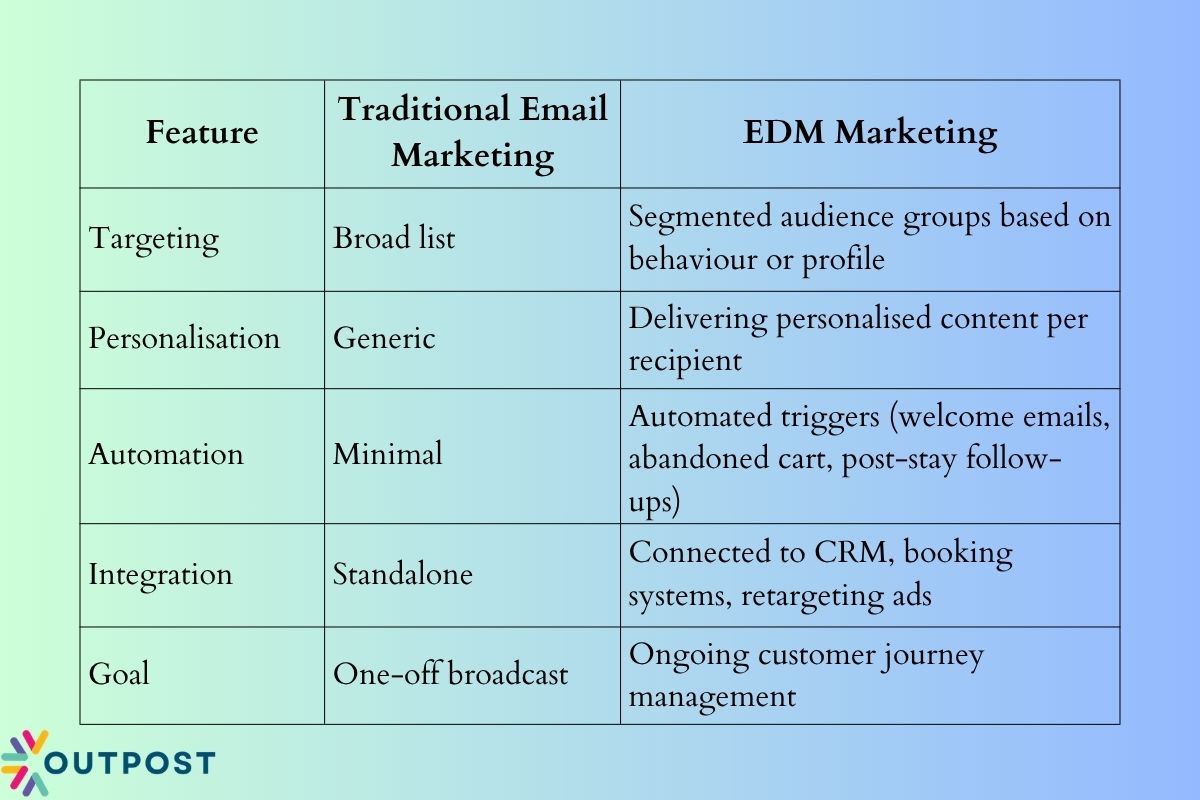
EDM marketing uses targeted outreach to build brand awareness, drive engagement, and move potential customers through a defined path toward making a purchase.
For hospitality businesses, that path is clear from email open, to enquiry, to confirmed booking.
What Goes Into an Effective EDM Campaign
To create an EDM marketing campaign that actually converts, you need more than a nice-looking email. Every component has a job to do.
Engaging subject lines are the first thing your audience sees. If your subject line doesn’t land, nothing else matters. Subject lines should be direct, relevant, and specific to the offer.
Segmentation is what separates a high-performing EDM from a generic blast. Grouping your email list by past stay history, booking frequency, or guest preferences means every message feels relevant. Guests who feel valued are far more likely to respond.
Personalised content goes beyond using someone’s first name. It means promoting offers that match what a specific audience segment actually wants, like a family rate for guests who booked with kids last time, or a corporate rate for frequent solo travellers.
Calls to action need to be specific and easy to act on. Whether it’s a “Book Now” button or a direct line to call, your CTAs should remove friction. One clear CTA per email almost always outperforms multiple competing options.
Automation handles the timing so you don’t have to. Welcome emails go out when someone signs up.
Abandoned cart follow-ups trigger when a booking isn’t completed. Post-stay messages go out a day after checkout to encourage loyalty and a return visit. These sequences keep your brand active in the customer journey without manual effort every time.
Metrics that matter include open and click-through rates, conversion rates, and ultimately, bookings attributed to each campaign. Tracking these tells you what’s working and what to adjust.
Why After-Hours Response Is Part of Your EDM Strategy
Here’s something that often gets missed in conversations about email marketing: an EDM marketing campaign doesn’t just drive traffic to a landing page. It drives phone calls, chat messages, and email enquiries, many of which come in outside business hours.
A guest opens your promotional email at 9pm. The subject line caught their attention. The offer looks good. They want to book a room for a long weekend. So they call. And no one picks up.
This is where most EDM campaigns leak. The email marketing worked. The open rates look good. The click-through rates are solid. But the conversion didn’t happen because the follow-through wasn’t there.
Data from the hospitality industry shows that after-hours silence pushes guests toward OTAs, which charge 15–25% in commission per booking. For a hotel doing volume, that adds up fast. After-hours support closes this gap
It keeps the conversation going when your in-house team has logged off, so the leads your EDM marketing generates actually convert.
One boutique hotel case study found that adding after-hours call support resulted in a 30% drop in missed calls and a 21% increase in direct bookings. The EDM campaigns didn’t change. The offers didn’t change. What changed was the ability to respond when guests were ready to book.
How to Align Your EDM Campaign with After-Hours Support
Getting these two things working together is where the real ROI shows up. Here’s what that alignment looks like in practice:
Brief your after-hours team on every active campaign. If your EDM is promoting a weekend spa package, the agents who pick up calls after hours need to know that package by name, know the price, and know how to convert the enquiry into a booking.
Consistency between your email marketing message and the live conversation is what makes guests feel like the experience is seamless.
Build your EDMs to signal 24/7 availability. If you have after-hours support, say so in the email. A simple line like “Our reservations team is available any time” removes hesitation for guests who might otherwise wait until morning by which point the impulse has faded.
Use CRM integration to give agents context. When a guest calls after seeing your EDM campaign, an agent with access to that guest’s booking history can have a much more personalised conversation.
This is where effective EDM marketing and good after-hours support create a compounding effect on loyalty and repeat bookings.
Track after-hours conversion data separately. Knowing how many bookings came from after-hours calls triggered by an EDM helps you measure the real impact of your campaigns. Open and conversion rates tell part of the story. Booking attribution tells the rest.
The Singapore Context: Why This Matters More Here

Singapore’s hospitality sector is operating at a high-demand baseline. Singapore Tourism Board (STB) data recorded S$23.9 billion in tourism receipts from January to September 2025, a record for that period, with hotel occupancy sitting at around 82%.
The visitors come from China, Australia, India, the UK, and beyond. Each of those markets sits in a different time zone.
A guest in Sydney who receives your EDM at 10am their time is enquiring at 7am Singapore time. A guest in London reading your email at 8pm their time is reaching out at 3am here. Without after-hours support, you’re essentially running an edm marketing campaign that generates leads you can’t catch.
This is particularly relevant for SMEs in hospitality who are competing with larger properties that have bigger teams.
Outsourced after-hours support levels the playing field. You get consistent, professional coverage without the cost of full-time night staff. No additional CPF contributions, no facility overhead, no management complexity.
Outpost‘s outsourced call centre service is built for exactly this use case. Businesses running marketing campaigns get dedicated support coverage that scales with volume whether it’s a one-off promotional blast or an ongoing email marketing strategy across multiple audience segments.
The Best Practices Checklist Before Your Next EDM Goes Out
Before you hit send on your next EDM campaign, run through this:
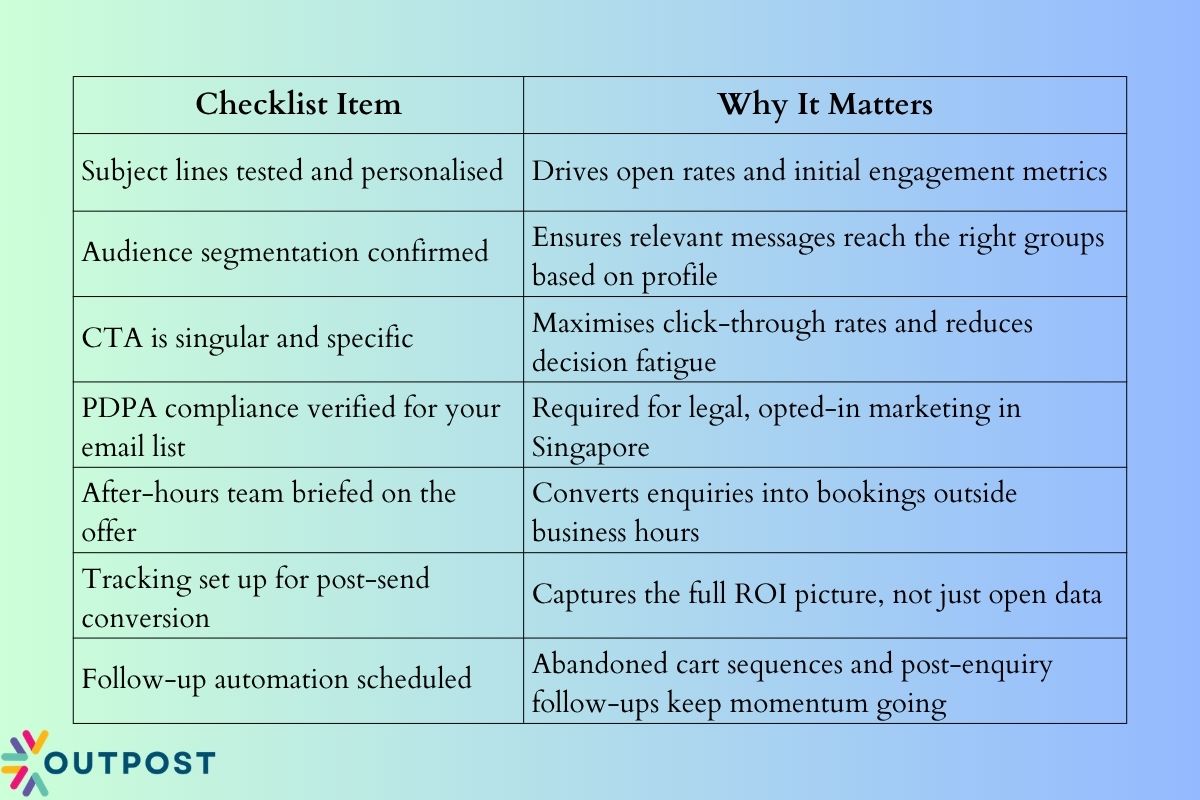
A successful EDM doesn’t stop at the send button. The brands that use email marketing most effectively treat it as an end-to-end system from building a high-quality email list of potential customers.
To crafting impactful messages that promote products or services people actually want, to having the support structure in place to handle the responses those messages generate.
Final Thoughts: Closing the Loop Between Your EDM and Your Guests
An EDM marketing campaign done well is a reliable, cost-effective way to boost sales and build brand loyalty over time. But the work doesn’t end when the email goes out.
The moment a guest decides to respond, your ability to be there and to be there fast is what determines whether that interest becomes a confirmed booking or a missed one.
After-hours support is not an add-on. It is part of the digital strategy. It’s what keeps your brand present and responsive during the hours when your guests are making decisions.
When your EDM marketing works and you have the people in place to receive that interest, you build relationships that compound over time.
That’s what drives sustained revenue not just for one campaign, but across every email marketing effort your business runs.
About the Author: Tansi G