


About 40% of veterinary inquiries happen outside normal business hours. Most of those calls go straight to voicemail when no one is available.
For a pet owner whose dog just swallowed something or whose cat stopped eating at midnight, that unanswered call breaks trust fast.
This is why after-hours customer service has become a genuine operational priority for pet care businesses.
This guide covers what a customer service representative does in this setting, what the job description looks like, and how outsourced teams fill the gap when in-house staffing falls short.
What Is a Customer Service Representative in Pet Care?

A customer service representative (CSR) in a veterinary or pet care business is the primary point of contact between the clinic and the pet owner. In the after-hours context, the CSR role goes well beyond taking bookings during office hours.
After-hours CSRs handle a mix of urgent and routine calls. They triage, schedule, document, and communicate. They relay updates to owners of hospitalised pets. They manage customer feedback and flag anything that needs a vet’s attention.
Working in customer service in a pet care setting means you are always dealing with people who care deeply about the animal on the other end of the conversation.
The job demands empathy, quick judgment, and strong communication in equal measure.
The Numbers Behind the Need
Singapore’s pet population has grown considerably. Licensed dogs rose from roughly 70,000 in 2019 to over 87,000 in 2022. Since September 2024, more than 41,000 cats have been registered under the national Cat Management Framework (CMF).
That is a large base of owners who may need support on a Sunday night or a public holiday morning.
Here is how after-hours veterinary calls typically break down:
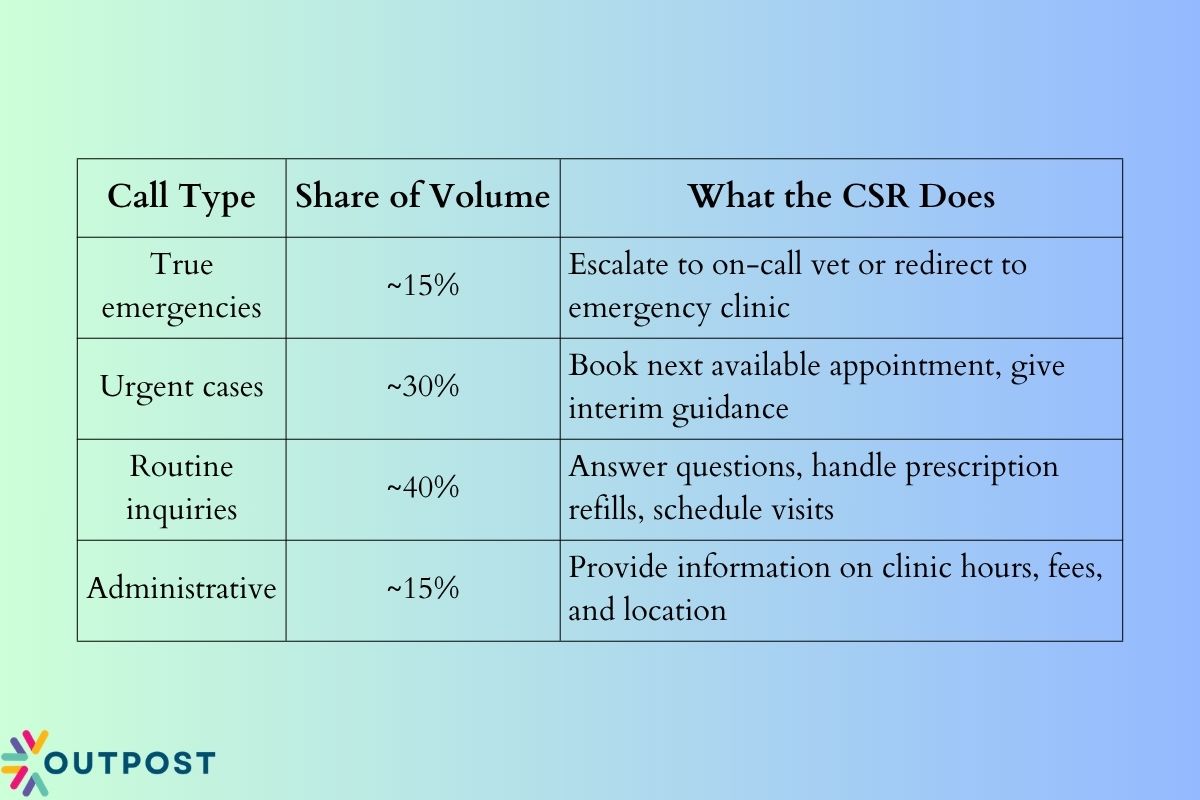
The key figure here is that 85% of after-hours calls do not require a veterinarian. They require a trained customer service representative who knows the protocols and can handle the conversation properly. That insight drives the entire case for dedicated after-hours coverage.
Key Duties and Responsibilities of a Customer Service Representative
Answering Every Call
The most basic customer service duty is also the most critical. When a pet owner makes phone calls after hours and someone actually picks up, it changes how that owner feels about the clinic permanently.
Customer service representatives work on forwarded lines in the evenings and weekends, making sure no inquiry gets dropped.
Triage and Escalation
CSRs follow a set protocol to identify which calls need immediate escalation. Signs like unconsciousness, suspected poisoning, or heavy bleeding trigger a specific response.
The agent connects the caller to an on-call vet or directs them to the nearest 24-hour facility. Problem-solving under real pressure is core to this duty.
Appointment Scheduling and Processing Orders
For urgent and routine calls, the CSR books the appropriate appointment. This requires familiarity with the clinic’s scheduling system, visit durations, and how to flag priority cases.
Some agents also process orders for prescription refills or post-visit care packages through the clinic’s system.
Answering Customer Questions
A significant share of after-hours customer inquiries involve questions about a pet’s medication, upcoming vaccines, or post-surgery recovery.
These are questions a trained CSR can handle without pulling a vet in. When an owner gets clear, useful answers about a product or service at 10 PM, the clinic earns real trust.
Handling Complaints and Difficult Conversations
Not every call is a medical concern. Sometimes a customer has had a negative experience and wants to speak to someone.
Handling complaints well, with active listening and genuine empathy, is a core part of the job description. Responding to complaints badly damages reputation. Resolving them well builds customer loyalty. There is no middle ground here.
Processing Payments and Administrative Tasks
After-hours CSRs sometimes handle payment processing, issue a refund on a cancelled booking, or manage the exchange of appointment slots.
These tasks and responsibilities sit alongside the clinical ones and require the same level of accuracy and professionalism.
Documentation and Logging
After each call, the CSR logs everything. Pet name, symptoms described, owner contact, advice given, follow-up actions. This gets entered into the clinic’s system or emailed to the team. When daytime staff arrive, they have the full picture. Nothing gets missed.
Updates for Hospitalised Pets
When a pet is admitted overnight, worried owners call for updates. After-hours CSRs coordinate with the on-site team to relay treatment status and results.
This is one of the most human parts of the role. It requires both accuracy and genuine empathy because you are talking to someone who is genuinely scared.
Customer Service Representative Job Description Template
This template works as a practical reference for clinics building out or evaluating an after-hours role. A solid service representative job description template for this context looks like this:
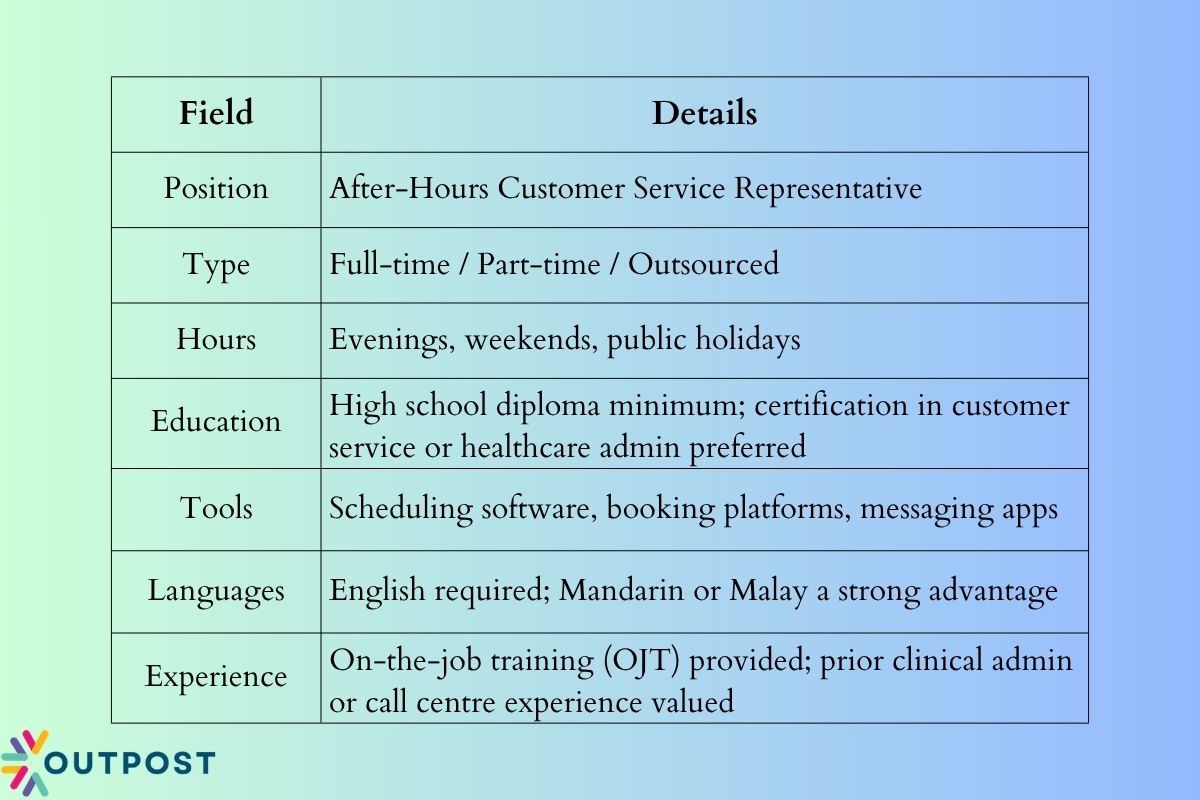
Customer service representative duties for this role:
- Serve as the first point of contact for all after-hours phone calls
- Triage and escalate emergencies following clinic protocols
- Schedule appointments and process orders through approved tools
- Answer questions and provide information about products and services, medications, and care instructions
- Resolve issues and handle complaints professionally
- Communicate with customers via phone, WhatsApp, or email
- Log every interaction accurately in the clinic’s system
Requirements and skills:
- Strong problem-solving skills and active listening ability
- Empathy when handling sensitive or distressing conversations
- Proficiency with scheduling and documentation tools
- Credential or certification in customer service is a plus
- Experience working in a clinical or call centre environment is an advantage
- Genuine desire to help customers and deliver excellent service
Where Do Customer Service Representatives Work in Pet Care?

Customer service representatives work across several settings in the pet industry. Knowing where they fit helps hiring managers scope the role and hiring a customer service representative for the right function.
- Veterinary clinics and hospitals — managing customer inquiries, appointments, and post-visit follow-ups
- Pet grooming studios and care chains — handling bookings, responding to customer needs, and managing complaints
- Pet product retailers — both in-person at retail stores and online, covering questions about products and services
- Pet insurance providers — processing claims, issuing refunds, and troubleshooting policy concerns
- Outsourced call centres — providing after-hours coverage for multiple veterinary clients simultaneously
This range is part of what makes a career as a customer service professional in pet care worth pursuing.
The customer service job description shifts depending on the setting, but the key duties and responsibilities stay consistent.
Customer Service Skills That Actually Matter Here
The requirements and skills for an after-hours CSR go beyond the standard checklist. Here is what separates a competent agent from a genuinely good one.
Empathy matters every single call.
Pet owners reaching out after hours are rarely calm. An agent who can communicate with warmth while keeping the conversation productive builds trust quickly.
Problem-solving skills are constant.
Every call presents a slightly different situation. The CSR assesses it fast, applies the right protocol, and moves things forward, often with limited information.
Active listening helps catch clinically relevant details.
A caller mentioning that their dog ate something unusual earlier in the day matters. An inattentive CSR might miss it entirely.
Clear communication prevents mistakes.
Owners acting on incorrect instructions about a product or service can cause real harm. Proficiency with documentation tools ties everything together.
When agents log properly and hand off cleanly, the daytime team picks up without confusion. Good documentation is also how clinics improve communication between shifts over time.
A customer service experience built in this environment, managing customer inquiries directly with customers under pressure, transfers well across the broader healthcare sector and beyond.
Why Clinics Use Outsourced Customer Support

Staffing an in-house team around the clock is expensive. An outsourced call centre covers evenings, weekends, and public holidays at a fraction of the cost of hiring full-time night-shift receptionists.
Outsourced agents answer phone calls under the clinic’s name, follow the clinic’s escalation protocols, and log every interaction in the agreed format. After-hours customer service is their primary function.
Outpost‘s outsourced call centre service offers flexible plans, from single-agent after-hours coverage to a fully managed 24/7 team.
Agents are trained in calm, empathetic communication, follow each client’s scripts precisely, and handle data in line with PDPA requirements. Multilingual agents are available for clinics serving Singapore’s diverse communities.
One clinic owner who moved to outsourced support said it significantly reduced her stress and freed up personal time. No more calls forwarded to her personal phone for questions a trained CSR specialist could handle.
Frequently Asked Questions
Do after-hours CSRs need medical training?
They need thorough on-the-job training (OJT) in triage and escalation procedures. A formal medical qualification is not required, but a certification in customer service or healthcare administration strengthens the role.
Hiring managers should look for candidates with strong problem-solving skills and a track record of experience working in high-pressure environments.
What is the career path here?
A career in customer service within veterinary settings can grow into senior CSR, team lead, or practice manager roles.
Customer service careers in this space carry real upward mobility. The customer service skills built here, especially troubleshooting, in-person and remote communication, and handling sensitive conversations, translate broadly across healthcare.
What makes after-hours coverage worth the investment?
Customer loyalty gets decided in the hardest moments to staff for.
A clinic that picks up at midnight and delivers excellent service earns the kind of reputation no ad spend can buy. Pet owners talk. They recommend the clinic that was there when they needed it, and they remember the one that was not.
Final Thoughts
Delivering after-hours care is a direct investment in veterinary practice.
Reliable customer service is the silent engine of growth in Singapore’s competitive pet care market.
By aligning the right job responsibilities with dedicated support, businesses can give the care that your pets deserve.
About the Author: Tansi G