
WhatsApp Business pricing is one of the first things Singapore SMEs want to understand before committing to the platform. The model is per-conversation, not per-message, and costs differ by message category.
This guide breaks down exactly how WhatsApp Business API pricing works in the Singapore market for 2026, covering every category, what is completely free, how the 24-hour window operates, and the practical strategies that keep costs manageable at scale.
Businesses managing growing digital teams can explore how Outpost, a virtual staffing agency, helps Singapore SMEs scale their customer communication and marketing functions without the overhead of full-time local hires.
Whether you are evaluating the platform for the first time or looking to optimise an existing setup, this guide covers the numbers, the logic, and the use cases that matter most.
WhatsApp Business App vs WhatsApp Business Platform: What You Are Actually Paying For
Understanding WhatsApp Business pricing starts with knowing which product you are on. There are two separate tiers, and they are not interchangeable.
The WhatsApp Business App is the free small version designed for sole proprietors and micro-businesses. It is completely free to download and use.
You get a business profile, basic automation like away messages and quick replies, and one-to-one customer messaging. What it does not offer is API access, broadcast messaging at scale, multi-agent inboxes, or CRM integration.
For very small operations, it works. For anything growing, it becomes a ceiling.
The WhatsApp Business Platform, formerly called the WhatsApp Business API, is what most businesses looking at whatsapp business pricing are actually asking about. This is the scalable version.
Access goes through a WhatsApp Business Solution Provider, also called a WABA partner or WABAS provider, and unlocks automation, chatbots, shared inboxes, integration capabilities with external CRMs and SaaS tools, and team collaboration across multiple agents. This is where per-conversation pricing applies.
WhatsApp Business Premium, also called Meta Verified, is a paid version of the WhatsApp Business app that adds multi-device support and a verified badge.
It sits between the free app and the full API platform. WhatsApp Business app offers like Premium are useful for sole proprietors wanting credibility, but they do not include the automation depth or broadcast capability of the full platform.
Conversation-Based Pricing: How the WhatsApp Business Pricing Model Works
The WhatsApp Business Platform uses conversation-based pricing rather than a per-message model. Instead of paying for each individual message you send, you pay once for a 24-hour conversation window.
All the messages you send and receive within that window fall under a single charge.
A conversation window opens the moment a qualifying message is delivered. The window stays open for 24 hours, and any messages within the 24-hour window, regardless of how many are exchanged, count as a single session.
When the window closes, the next message opens a new conversation and a new charge applies.
This pricing model benefits businesses with complex customer interactions. A support issue that requires ten messages back and forth costs the same as a single message, provided everything stays within the 24-hour window.
It also makes costs predictable month to month, especially once you understand your typical conversation volume by category.
The pricing model is organised into four message categories. Each category has a different rate, and the category assigned to a conversation determines what you pay.
Understanding which category each of your message types falls into is the foundation of managing your WhatsApp API costs effectively.
WhatsApp Message Categories and Singapore Pricing
Meta divides all WhatsApp Business Platform conversations into four categories. The category depends on who initiated the conversation and what the message is for.
Marketing Conversations
A marketing conversation is business-initiated and promotional in nature. Discount campaigns, product launch announcements, re-engagement messages, and event invitations all fall here.
These are the most expensive category because they are outbound and commercially driven. In Singapore, the estimated rate is approximately SGD 0.078 per conversation window.
Marketing automation flows that send messages you initiate also fall into this category, so volume here scales directly with your campaign frequency.
Utility Conversations
Utility conversations are also business-initiated but are transactional rather than promotional. Order confirmations, shipping notifications, appointment reminders, and payment receipts are all utility messages.
The estimated Singapore rate is approximately SGD 0.038 per session.
Certain utility template messages sent within 24 hours of a customer completing an action may qualify for free delivery under Meta’s updated pricing policy, which is covered in the free allowances section below.
Authentication
Authentication covers one-time passwords and verification codes. These are short, functional messages with no commercial content. The estimated Singapore rate is approximately SGD 0.028 per session.
High-security industries including fintech and healthcare use authentication messages heavily for every login attempt and transaction confirmation.
Service Conversations
Service conversations are customer-initiated. When a user sends your business the first message, whether asking about pricing, a product, or a complaint, that opens a service conversation.
The estimated Singapore rate is approximately SGD 0.026 per session, and the first 1,000 service conversations every month are completely free.
Service messages account for the bulk of inbound support activity for most SMEs, making this free tier genuinely valuable.
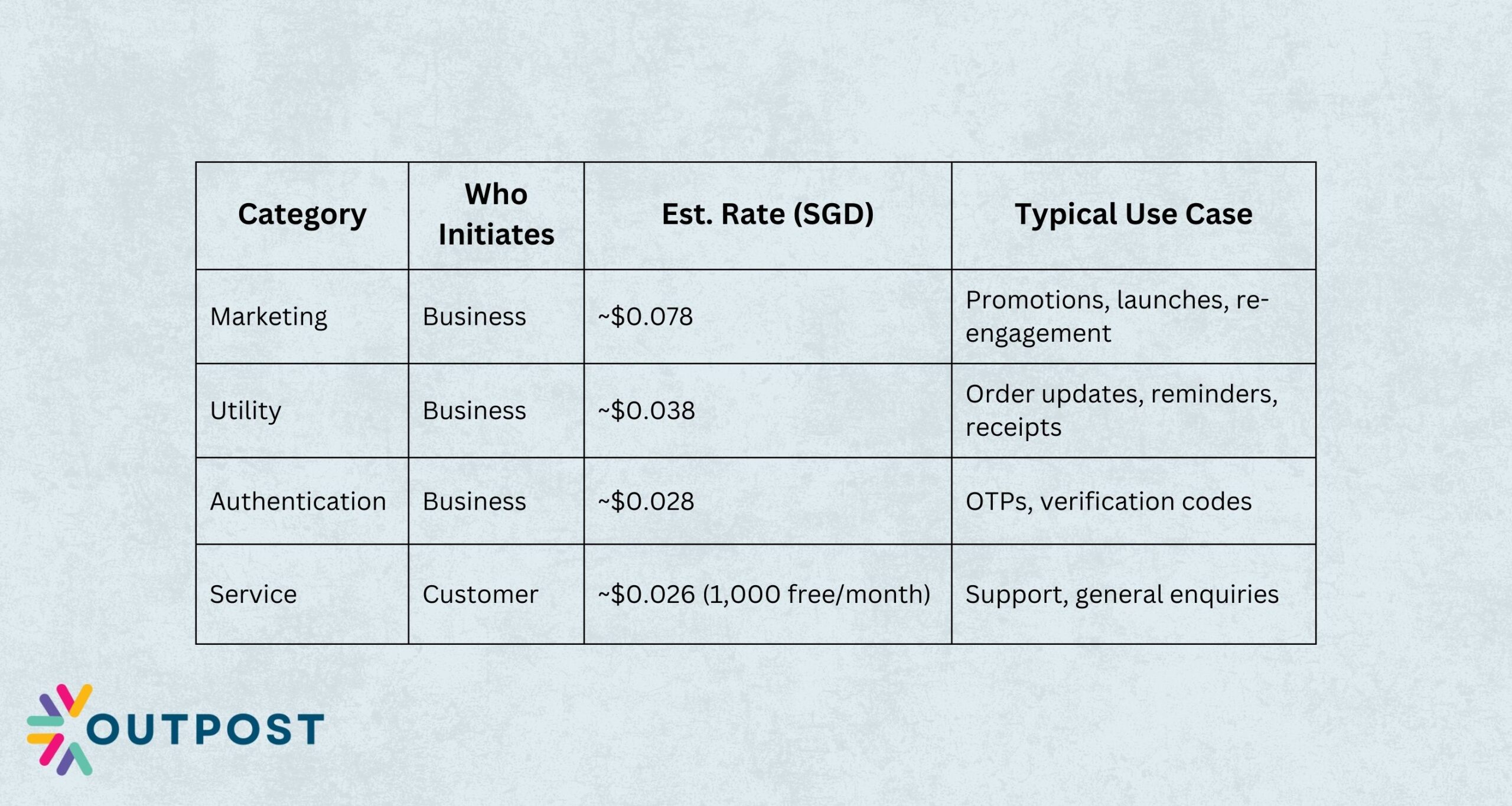
These Singapore figures are estimates based on 2026 exchange rates. Currency fluctuations affect the SGD equivalent of Meta’s USD-denominated rates.
Always verify your actual costs against the billing dashboard in your Meta Business Manager.
What Is Free on the WhatsApp Business Platform
1,000 Free Service Conversations Monthly
Every WhatsApp Business account receives 1,000 free service conversations each month.
This allowance resets at the start of every billing cycle. For businesses where most customer communication is inbound, this free tier can cover a large share of monthly activity at no charge.
The 1,000 free sessions apply only to service conversations opened by user messages, not to business-initiated categories.
Free Utility Template Messages
Under Meta’s updated pricing policy introduced in 2025, certain utility template messages are now delivered free of charge.
Specifically, utility templates sent within 24 hours of a customer completing a purchase or relevant transaction qualify for free delivery.
This means post-purchase confirmation flows, shipping updates, and similar transactional sequences often cost nothing under the new policy, significantly reducing the whatsapp api costs for e-commerce and logistics businesses that send high volumes of these messages.
Free Entry Points and the 72-Hour Free Window
Free entry points are one of the most cost-effective mechanisms on the platform. When a customer initiates a conversation via whatsapp through a Click-to-WhatsApp ad on Facebook Business or Instagram, the conversation that follows is free for 72 hours.
A 72-hour free window means three full days of messaging with no per-conversation charge, on top of whatever was spent on the ad click itself.
For campaigns with high-value leads, routing acquisition through Click-to-WhatsApp ads converts ad spend into extended free conversations rather than triggering expensive outbound marketing sessions.
Free entry points are particularly effective for real estate, high-ticket retail, and professional services where a single closed deal justifies the ad investment many times over.
Billing on the WhatsApp Business Platform

Billing is managed through Meta Business Manager and aggregated monthly by conversation category. Charges are applied against the payment method on file, and businesses can set spending caps to prevent overruns during high-volume campaigns.
The billing dashboard shows a breakdown of conversation volumes and costs by category, which is the most direct way to see where your budget is going each month.
Conversation windows are tracked automatically. When a window opens, it is logged against your account in the relevant category. When the conversation closes, the session count is finalised.
Messages within an existing open window do not open new sessions or incur additional costs. Understanding exactly when a window opens and closes is important for businesses managing tight monthly budgets.
A conversation initiated by a customer opens a service window. A message you send first opens either a marketing, utility, or authentication window depending on its content and purpose.
Additional costs beyond per-conversation fees can include subscription fees from your Business Solution Provider or WABA platform, template approval costs in some setups, and charges for additional phone numbers or WhatsApp Business accounts if you are running multiple numbers.
These vary by solution provider and should be clarified upfront when choosing the right platform partner.
Analytics and Performance Tracking
The WhatsApp Business Platform includes a native analytics dashboard covering message delivery rates, read rates, response rates, and conversation volumes segmented by category.
For businesses running regular campaigns, tracking these metrics is how you understand which message templates perform well and which need revision.
Read rates on WhatsApp consistently run between 85 and 95 percent, which is substantially higher than email at 20 to 30 percent.
This makes the per-conversation cost easier to justify when measured against actual engagement. A marketing message that costs SGD 0.078 and reaches someone who actually reads it compares very favourably to an email that reaches someone who may never open it.
Beyond the native dashboard, businesses using a WABA platform from a third-party solution provider typically get enhanced analytics including conversation flow maps, drop-off points in automated sequences, and agent performance reports for teams handling inbound messages.
These additional analytics are useful for businesses with high conversation volumes who want to optimise both cost and quality simultaneously.
WhatsApp vs Email vs SMS: Cost Comparison
Comparing whatsapp business pricing against other channels gives a clearer picture of where it sits in a broader marketing and customer communication budget.
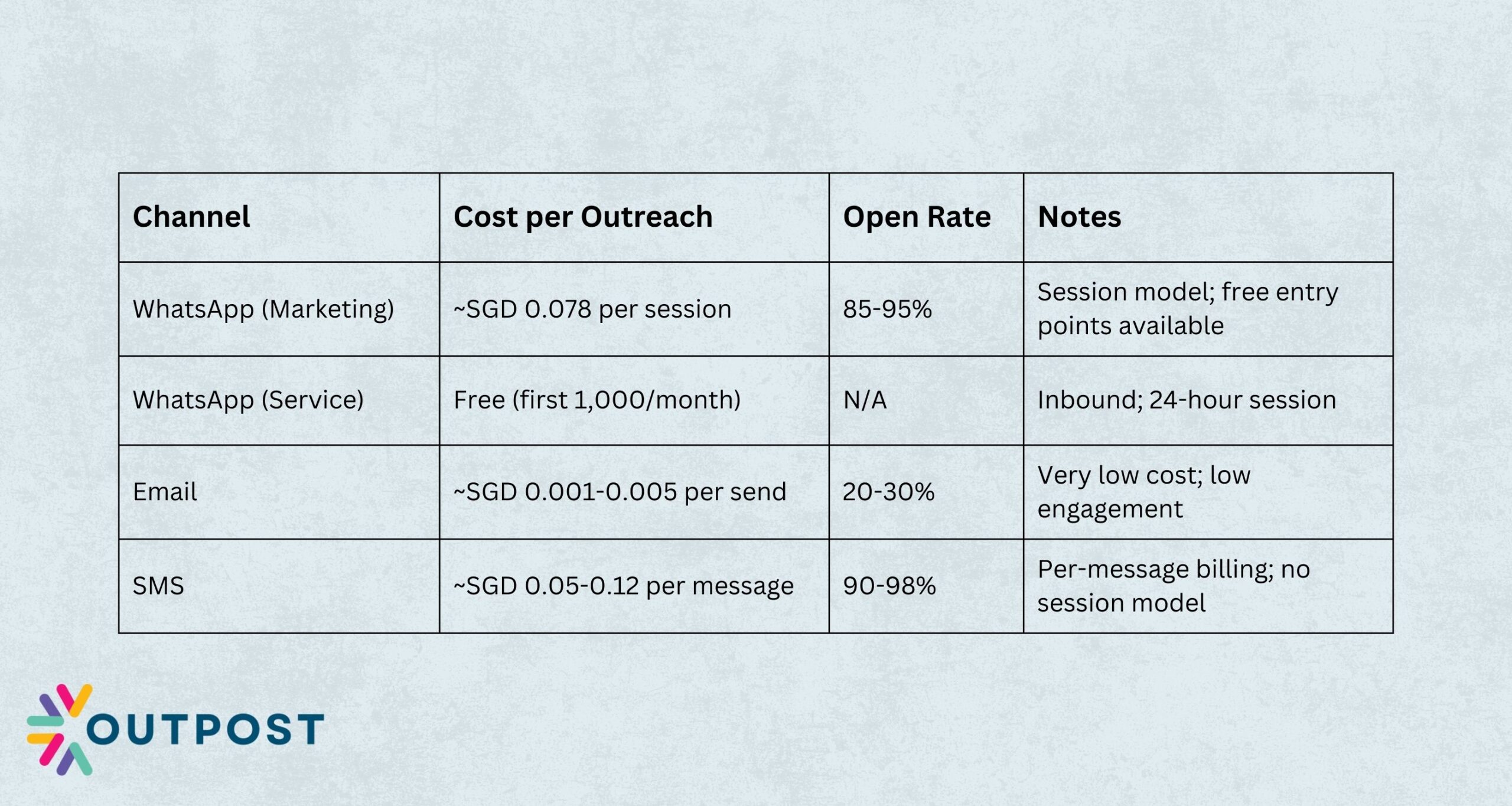
WhatsApp costs more per outreach than email, but the open rate gap is dramatic. For customer messages that need to be read and acted on, the effective cost per meaningful engagement often favours WhatsApp.
SMS reaches comparable open rates but uses per-message billing with no session model, no rich media support, and no integration capabilities.
For business communication that needs context, conversation, and follow-through, WhatsApp for business is the stronger channel at most price points.
New Pricing Policy for AI Providers on the WhatsApp Business Platform
Meta introduced a separate pricing framework in 2025 for businesses deploying AI agents on the WhatsApp Business Platform.
This new whatsapp business pricing tier is designed specifically for automated, AI-driven interactions at scale and uses the Cloud API and Marketing Messages API as its infrastructure layer.
For Singapore businesses using AI chatbots for first-line service, lead qualification, or automated order processing, this pricing framework is worth reviewing in detail with your solution provider.
The Cloud API removes the need for a dedicated server infrastructure, which reduces setup costs for businesses wanting to integrate whatsapp into automated workflows.
Rates and conditions for AI Provider accounts are subject to ongoing updates from Meta, so confirming current terms directly with your WABA or solution partners is recommended.
Tips to Reduce WhatsApp API Costs
Reducing your WhatsApp spend without reducing communication quality is achievable with a few deliberate habits built into how you run campaigns and manage conversations.
Leverage Free Conversation Tiers
- Exhaust your free service conversations first: The 1,000 monthly free sessions reset every billing cycle. Structure inbound support workflows so customer messages initiate conversations wherever possible, keeping costs at zero for that volume of activity.
- Use free entry points for high-value campaigns: Route acquisition campaigns through Click-to-WhatsApp ads on Facebook Business to unlock the 72-hour free window. Conversations initiated this way cost nothing on the WhatsApp side for three full days.
Strategic Message Timing
- Batch messages within the 24-hour window: When you need to send multiple messages to the same customer in a short period, time them within a single open conversation window rather than letting the window close and opening a new one. Messages within the 24-hour window are covered by the original session charge.
- Apply free utility template messages to post-purchase flows: Under Meta’s updated policy, utility templates sent within 24 hours of a completed transaction often qualify for free delivery. Structuring your order confirmation and shipping notification sequences to meet this criterion removes those messages from your monthly cost entirely.
Automation and Monitoring
- Use chatbots for first-line responses: A well-built chatbot can respond within seconds to common inbound queries and resolve a significant percentage of them within the free service tier. Saving human agents for complex issues keeps your paid conversation volume low.
- Monitor billing weekly: Unexpected spikes in marketing conversation volume are the most common cause of budget overruns. Catching them early in the billing cycle allows you to adjust campaign pacing before the month-end invoice arrives.
Local Financial Support
- Apply for the PSG grant: Eligible Singapore businesses can offset a substantial portion of their WhatsApp Business Platform costs through government co-funding. See the PSG section below for details.

WhatsApp Business Platform Pricing Examples
Abstract rates become more useful when mapped to real scenarios. Here are concrete examples of how WhatsApp Business API pricing plays out across different business operations.
Example 1: Monthly Promotional Campaign
A retail business sends a marketing message to 5,000 opted-in customers announcing a weekend sale. Each message opens a marketing conversation window at approximately SGD 0.078.
Total messaging cost for that broadcast: SGD 390. If the campaign converts at 3% with an average order value of SGD 120, the return is SGD 18,000 against a SGD 390 messaging spend.
That is a scalable, measurable ROI that most other channels cannot match at comparable engagement rates.
Example 2: Post-Purchase Transactional Flow
An online store processes 2,000 orders monthly and sends automated confirmation and shipping update messages for each.
With free utility template messages applying to post-purchase flows under the updated 2025 policy, a significant portion of these conversations may be delivered at no charge.
Even at full rate, 2,000 utility sessions at SGD 0.038 amounts to SGD 76 for an entire month of transactional customer communication.
Example 3: Inbound Support Operation
A service business receives 800 inbound customer queries per month. With 1,000 free service conversations included monthly, the full inbound support operation runs at zero WhatsApp cost.
The business only needs to budget for its platform subscription and staffing, not for per-conversation message fees.
WhatsApp Business Use Cases by Industry
The platform’s value and cost profile varies by industry. Here is how different sectors in Singapore use WhatsApp Business and which conversation categories dominate their spending.
Retail and E-commerce
Retailers use marketing conversations for promotions and restocking alerts. Utility and authentication messages handle order flows and account verification.
Free utility template messages apply to most post-purchase sequences, keeping transactional costs very low.
The combination of high open rates and low transactional costs makes WhatsApp the strongest CRM integration point for e-commerce businesses managing large customer bases.
Real Estate
Property agents send new listing alerts and viewing invitations as marketing conversations. The platform supports rich media including floor plans, images, and brochures directly in the chat.
Chatbots handle initial lead qualification and appointment booking, reducing the number of conversations that require live agent time.
Because a single closed deal generates significant revenue, even a high volume of marketing conversations represents a small fraction of the deal value.
Healthcare
Appointment reminders are utility messages and often qualify for free utility template message treatment. Authentication messages secure patient portal access.
The end-to-end encryption and PDPA-compliant data handling make WhatsApp appropriate for clinical communication when configured correctly. Clinics should confirm data processing agreements with their WABA provider to ensure full regulatory alignment.
Education
Tuition centres and training providers handle parent and student enquiries as service conversations, often fully covered by the free monthly tier.
Marketing automation flows announce new programmes and enrolment windows. Utility messages deliver fee receipts and schedule updates automatically, reducing administrative workload significantly.
Professional Services
Law firms, accounting practices, and consultancies send utility messages when documents are filed or reports are ready. Integration capabilities with practice management software via webhook allow status updates to trigger automatically without manual intervention.
Team collaboration across multiple agents handling different client files is one of the core reasons professional service firms choose the full API platform over the free app.
Finance and Fintech
Authentication is the dominant message type for financial businesses, used for every transaction verification and login attempt. Marketing conversations promote new products and services.
The platform’s encryption meets the security standards required for financial communication in Singapore, and businesses with high authentication volumes benefit from the low per-session rate at scale.
Logistics
Delivery alert messages dispatched when a driver approaches the recipient’s address reduce missed delivery rates and customer service call volumes simultaneously.
Customers can respond within the same conversation window to reschedule or redirect deliveries.
The automation here is straightforward to implement via webhook and delivers immediate operational cost savings that outweigh the per-conversation fees.
Hospitality
Hotels treat WhatsApp as a digital concierge channel. Guests initiate service conversations for room requests, dining reservations, and local recommendations, most of which fall within the free service session tier.
Post-stay marketing messages offering return visit discounts are low-cost follow-ups given WhatsApp’s high open rates.
Customer messages in hospitality tend to be high-frequency but short, making the session model more economical than per-message billing.
Manufacturing and Supply Chain
Factories use WhatsApp to coordinate with suppliers and delivery partners in real time. Automated utility alerts for low stock levels prevent production delays.
The per-message cost is negligible relative to the operational savings from preventing a single production line stoppage.
Receiving messages from multiple supply chain partners through a unified inbox rather than scattered phone calls also improves coordination accuracy significantly.
Getting Started with WhatsApp Business API
Accessing the WhatsApp Business Platform requires going through a Meta-approved Business Solution Provider. You cannot sign up directly via the WhatsApp app.
The setup process involves verifying your WhatsApp Business account with Meta, which requires business registration documents and a phone number not currently linked to any WhatsApp account.
Once verified, you receive access to message template creation, the shared team inbox, CRM integration, and the broadcast tool. Message templates must be submitted to Meta for approval before use.
Reviews typically take a few hours to a day and check for spam signals, prohibited content, and formatting compliance. Pre-approved templates can be sent immediately, while new templates enter the review queue.
Setting up webhooks connects your external business systems to the WhatsApp platform in real time. When an order is placed on your website, a webhook can trigger an automatic WhatsApp confirmation.
When a customer updates a delivery address in your CRM, a webhook sends the revised confirmation without any manual action. Choosing the right WABA platform partner determines how much of this integration capabilities work is handled for you versus built from scratch.
SaaS-based platforms from established solution partners typically include pre-built connectors for common CRM and e-commerce tools, which reduces time to launch considerably.

Using the PSG Grant to Reduce WhatsApp Business Costs in Singapore
The Singapore government’s Productivity Solutions Grant (PSG) provides co-funding of up to 50% for approved digital tools, including WhatsApp Business Platform subscriptions and setup fees.
Applications are submitted through the GoBusiness portal.
To qualify, your business must be registered and operating in Singapore with at least 30% local shareholding. The solution must be purchased from a pre-approved vendor listed on the portal.
The PSG significantly reduces the effective whatsapp api costs for first-year implementation. For businesses on the fence about moving from the free app to the full API platform, the grant often makes the decision straightforward.
Working with a pre-approved vendor simplifies the application process because these providers are familiar with the documentation requirements and submission procedures.
Businesses handling customer data via WhatsApp should also review the Personal Data Protection Commission’s guidance on consent management and data handling obligations.
The PDPC website publishes advisory guidelines for businesses using messaging platforms at scale, covering opt-in requirements, data retention, and breach notification obligations.
How to Calculate Your WhatsApp Business API ROI
WhatsApp Business API pricing only makes sense when measured against returns.
The starting point is your billing dashboard, which breaks down monthly conversation volume by category. From there, map each category to a business outcome.
Marketing conversations should be tracked against open rates, response rates, and eventual conversion rates.
If conversations initiated this month produced X in revenue, divide that by the total marketing conversation spend to get your cost per acquisition. Utility conversations reduce customer service call volumes, and the staff time saved is a real cost reduction.
Authentication messages reduce fraud losses. Service conversations resolved within the free tier represent pure cost avoidance.
A practical benchmark for Singapore businesses: a marketing conversation at SGD 0.078 that leads to a transaction worth SGD 200 represents a cost of acquisition well under 0.1% of transaction value.
Compare that to paid search advertising in competitive Singapore verticals where a single click can cost SGD 5 to SGD 20, and the ROI case for WhatsApp becomes straightforward. The key metric is not cost per message but revenue or savings per conversation, tracked consistently month over month.
How Outpost Supports WhatsApp-Driven Marketing Teams
Running an effective WhatsApp Business operation takes more than platform access. It requires consistent template creation, campaign planning, response management, and performance analysis.
For many Singapore SMEs, the internal capacity to handle this well at scale is the real constraint, not the cost of the platform itself.
Outpost is a virtual staffing agency that helps Singapore businesses build dedicated remote marketing teams. Rather than hiring a full-time local coordinator to manage WhatsApp campaigns, content calendars, and customer communication workflows, businesses work with
Outpost to access trained remote staff who integrate directly into existing tools and processes.
This model fits particularly well for SMEs scaling their WhatsApp presence quickly, where template creation, campaign scheduling, and inbound response management outpace what a small internal team can handle.
WhatsApp Business Pricing: Final Takeaways for Singapore Businesses
WhatsApp Business pricing in Singapore is more manageable than most businesses assume before they dig into the details. The conversation-based pricing model rewards efficiency.
The free service tier and free utility template messages cover a meaningful share of routine communication at no cost.
Free entry points and the 72-hour free window make lead nurturing significantly cheaper than cold outbound marketing. And the PSG grant reduces first-year costs substantially for eligible businesses.
The practical starting point is straightforward. Classify your expected conversation volumes by category, map them to the rate benchmarks in this guide, factor in your free allowances, and run the numbers against the value of what those conversations are worth to your business.
For most Singapore SMEs, the ROI case is not difficult to make. The question is usually less about whether to use the platform and more about how to set it up correctly and who will manage it ongoing.
Used well, WhatsApp for business delivers one of the strongest returns on customer communication investment available in Singapore today.
About the Author: Tansi G