
Running an online store in Singapore means managing customer interactions across Shopify, Lazada, Shopee, WhatsApp, and email — all at once.
When support is scattered, tickets get missed, response times suffer, and the ecommerce customer experience deteriorates fast. That is where ecommerce help desk software makes the difference.
A good platform centralises customer support in one organised workspace — pulling every inbound message into a helpdesk dashboard where your team can respond, automate, and report from a single screen. Help desk software centralizes customer conversations so nothing falls through the cracks.
Some Singapore SMEs complement their support tools by outsourcing to a virtual staffing agency like Outpost, which provides trained remote agents who know how to operate these platforms — so business owners are not personally handling every customer query.
This guide covers the list of the best seven platforms available as solutions for 2026 — what to look for, how the tools compare, and how to choose the right fit for your business needs.
What Exactly Is Ecommerce Help Desk Software?

Ecommerce help desk software is a customer support software platform built to centralise all support activity in one place.
Instead of juggling separate inboxes for email, live chat, social media, and marketplace messages, the support software pulls every conversation into a single helpdesk dashboard — organised, prioritised, and actionable.
Unlike a generic CRM or basic ticketing system, this type of platform is built specifically for online retail.
Agents can view a customer’s order history, process refunds, update shipping details, and respond to tickets from within the same interface. No tab switching. No duplicated effort.
At its core, the modern help desk converts every inbound message into a structured support ticket.
Each ticket carries context — which channel it came from, what was ordered, and how long it has been waiting — so agents can respond with full information rather than starting from scratch on every case.
That is what separates modern help from a basic shared inbox.
Why Singapore SMEs Need It in 2026
Singapore’s ecommerce businesses are operating in one of Southeast Asia’s fastest-growing digital markets.
According to GlobalData, the ecommerce store landscape is forecast to reach SGD 40.5 billion by end of 2026 — a 17.7% year-on-year increase. As order volumes grow, so does the pressure on customer support.
For small businesses managing support manually across multiple channels, the breaking point comes quickly. Response times slow. Messages get missed.
The customer experience suffers. Research shows that teams using a helpdesk system resolve support tickets approximately 53% faster than those that do not.
There is also a revenue angle. More than 83% of shoppers require some form of assistance during the purchase process.
Ecommerce operations that invest in structured, responsive support convert and retain customers more effectively — making the right platform a growth tool, not just a cost management decision.

What to Look for in Ecommerce Help Desk Software in 2026
Not all platforms are equal. Here are the help desk features that matter most for teams managing support at scale.
Omnichannel Support and Ticket Management
Your customers contact your business through email, live chat, Facebook, Instagram, WhatsApp, and marketplace inboxes.
The best help desk platforms deliver omnichannel support — pulling all of those channels into one ticket management dashboard where every conversation is tracked from open to resolution.
When support is this centralised, fewer customer questions get dropped.
Automation That Reduces Repetitive Work
A strong service management platform lets you automate ticket routing, send pre-written replies, and trigger workflow rules based on channel, keyword, or priority.
Look for platforms that allow you to automate the most common query types — so agents spend their time on conversations that actually need a human response rather than on manual work.
Ecommerce Platform Integrations
Native integrations with Shopify, WooCommerce, Lazada, Shopee, and Amazon are non-negotiable. Without them, agents are manually switching between systems for every single ticket.
The best support software surfaces order data directly within the ticket — eliminating that friction entirely.
Analytics, Reporting, and Service Delivery
Analytics dashboards give you visibility into what is actually happening in your support operation — resolution times, channel performance, agent productivity, and support trends.
Solid service delivery depends on having this data available and easy to act on. Platforms with strong reporting help managers make informed decisions about workflows and resourcing.
Self-Service Portal and Knowledge Management
A self-service portal backed by a well-organised knowledge base reduces inbound ticket volume by helping customers find answers independently.
Knowledge management features — article creation, tagging, and searchability — allow teams to build a resource library that handles customer questions before they reach an agent. This is especially valuable for technical support queries that repeat frequently.
Scalability and Pricing
The right platform grows with your business. Look for tiered pricing that lets you start lean and expand as ticket volumes increase.
Many platforms offer a free plan or a trial period — use that window to test the tool against your actual workflow before committing.
A Quick Comparison of the Best Ecommerce Help Desk Software in 2026
Finding the best ecommerce help desk software means weighing your priorities across these seven help desk platforms.
Here is a snapshot of the top help desk software options — covering what each does best, pricing, and availability of a free plan or trial.
The table below summarises the seven help desk software solutions covered in this guide. Use it as a starting reference before diving into the individual reviews.
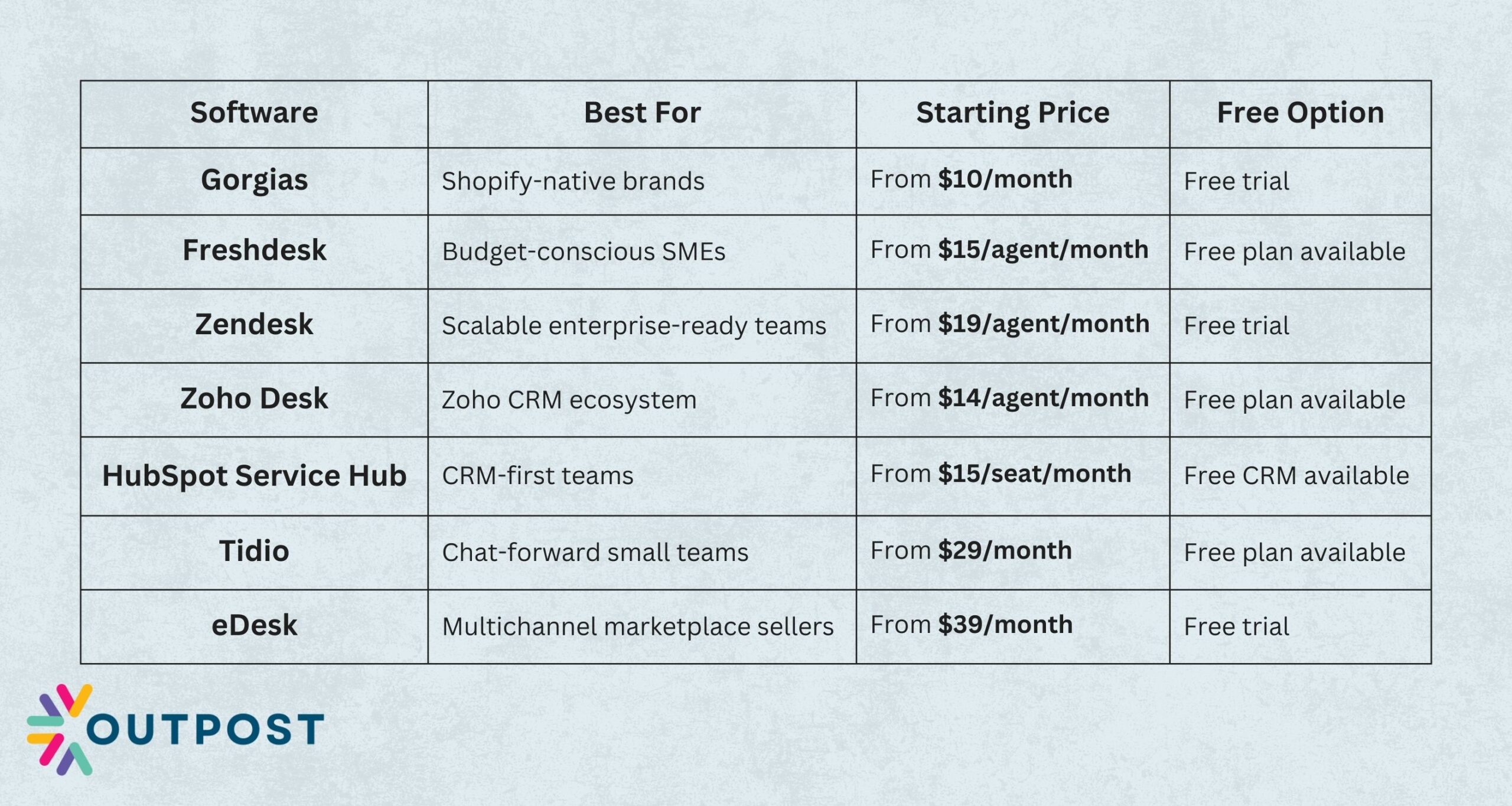
Desk software options in 2026 vary widely in depth and price point.
Whether you need a simple customer service platform for basic ticketing or a full-featured enterprise tool, this list has a fit for each stage of growth.
The 7 Best Ecommerce Help Desk Software for Singapore SMEs
1. Gorgias
Gorgias was built specifically for ecommerce, and that focus is apparent in nearly every feature.
The platform’s standout strength is its deep native integration with Shopify, Magento, and BigCommerce — pulling customer and order data directly into each support ticket so agents have full context before typing a single word.
Rather than leaving the helpdesk to check another system, agents can issue refunds, edit orders, apply discount codes, and update shipping details without leaving the ticket view.
This is what separates Gorgias from a general-purpose tool: it lets agents manage customer and order information side by side, in one place, without ever leaving the help desk.
Automation is equally strong.
Order status checks, return requests, and delivery questions can all be resolved automatically using rules tied to live order data. This reduces incoming support volume significantly, freeing the support team to focus on conversations that require real judgment.
Gorgias pricing starts at $10/month based on ticket volume rather than seat count — a cost structure that works well for lean teams managing high order volumes. A free trial is available to test the platform before committing.
Best for: Shopify merchants that want deep ecommerce integration and automation built for online retail.
Pricing: From $10/month. Free trial available.
2. Freshdesk
Freshdesk strikes a practical balance between capability and accessibility. The free plan supports up to 10 agents — one of the most generous entry points among all help desk software options currently available.
Paid plans start at $15 per agent per month, keeping costs manageable as the team grows.
The platform delivers omnichannel support across email, live chat, phone, and social media through a clean, user-friendly dashboard.
Ticket automation, canned responses, collision detection, and a self-service portal backed by a knowledge base are all available at the lower pricing tiers.
Freshdesk integrates with Shopify, WooCommerce, and several marketplace platforms — allowing agents to view order data without leaving the helpdesk. More advanced automation and AI features are available on higher-tier plans, which is worth noting if automation is a day-one priority.
For a Singapore SME that needs a reliable and cost-effective starting point, Freshdesk is one of the more accessible help desk software solutions on the market. Setup is fast, onboarding is straightforward, and the platform scales cleanly as ticket volume grows.
Best for: Small businesses that need an accessible, scalable entry-level helpdesk.
Pricing: Free plan available; paid plans from $15/agent/month.
3. Zendesk
Zendesk is one of the most widely recognised names in customer support software — and the depth of its platform justifies that reputation.
Its workflow builder, breadth of integrations, and enterprise-grade analytics make it a serious option for teams managing high ticket volumes across multiple channels.
The platform’s app marketplace includes thousands of integrations covering major ecommerce platforms, CRM systems, email marketing tools, and communication channels.
The automation builder allows complex routing logic to be configured without developer involvement. Support for multiple channels is handled through a unified agent workspace.
Analytics are a particular strength. Dashboards provide visibility into resolution times, agent productivity, channel performance, and CSAT scores — giving managers the data to make decisions that improve every stage of customer support delivery.
Every customer record is accessible within the ticket, so agents have context before engaging.
The trade-off is setup complexity. Zendesk is powerful but can feel over-engineered for very small teams. Pricing starts at $19/agent/month, with AI features typically sold as separate add-ons.
Best for: Growing businesses that need a scalable, customisable helpdesk with enterprise-grade reporting.
Pricing: From $19/agent/month. Free trial available.
4. Zoho Desk
Zoho Desk is the natural choice for businesses already using the Zoho ecosystem — particularly Zoho CRM, Zoho Commerce, or Zoho Inventory.
The integration between Zoho Desk and Zoho CRM is tight, giving agents an immediate and complete view of every customer’s past support history, purchase activity, and open conversations, all from one screen.
The platform’s AI assistant, Zia, handles ticket classification, sentiment tagging, and automatic assignment.
For teams managing steady incoming volume, this intelligent routing reduces manual triage meaningfully. Agents spend less time deciding where to send tickets and more time actually resolving them.
Zoho Desk’s free plan covers up to three agents. Paid plans begin at $14/agent/month — positioning this among the strongest value propositions in the current desk software options in 2026 landscape.
Omnichannel support spans email, live chat, social media, and phone, and the customer journey is tracked across every touchpoint within the Zoho ecosystem.
One limitation: Zoho Desk does not offer native marketplace integrations for platforms like Lazada or Amazon. Connecting these requires third-party configuration. For businesses selling through their own site, this is rarely an issue.
Best for: Teams in the Zoho ecosystem that want CRM-connected support with AI-assisted ticket triage.
Pricing: Free plan (up to 3 agents); paid plans from $14/agent/month.
5. HubSpot Service Hub
HubSpot Service Hub places customer support inside a broader CRM and marketing automation environment.
Every support ticket, email exchange, and sales call is logged in the same CRM record — giving agents a complete picture of every customer’s relationship with the brand, including customer relationships that originated in sales or marketing.
This makes HubSpot Service Hub particularly useful for businesses where support and sales overlap. An agent handling a complaint from a customer who also has an active sales conversation can see that full context immediately, without leaving the help desk.
The platform includes a shared inbox for team collaboration, AI-assisted reply drafting, customer feedback tools, a knowledge base, and a self-service portal. The HubSpot service interface is clean and the reporting covers standard support metrics alongside satisfaction scores tied back to CRM data.
HubSpot’s free CRM provides an accessible starting point. The HubSpot service hub paid plans begin at $15/seat/month.
For Singapore SMEs already using HubSpot for marketing, adding the service hub creates a genuinely unified customer management environment.
Best for: Businesses already using HubSpot CRM that want unified support, sales, and marketing in one platform.
Pricing: Free CRM available; paid plans from $15/seat/month.
6. Tidio
Tidio is a chat-forward helpdesk that combines live chat, an AI bot called Lyro, and ticket management into a lightweight, fast-to-deploy package.
For small teams that want to add responsive customer support to their Shopify or WooCommerce store quickly, Tidio is one of the simplest paths to getting up and running.
Lyro handles incoming customer queries automatically — answering FAQs, providing order updates, and routing conversations to human support agents when required.
This keeps incoming support volume manageable even for very lean teams, and it provides coverage outside business hours.
Tidio integrates directly with Shopify and WooCommerce, letting agents view customer data within the live chat interface.
Email and social channels connect as well, though the platform is strongest as a website chat and automation tool. The current help desk view is clean and easy for new agents to navigate.
A free plan is available with core features. Paid plans start at $29/month. Many platforms offer free access to test core features — Tidio is among those that does this well, with a generous free tier that lets small teams build confidence in the tool before upgrading.
Best for: Small teams that want fast, chat-first support with AI automation and minimal setup.
Pricing: Free plan available; paid plans from $29/month.
7. eDesk
eDesk was built for multichannel marketplace sellers — specifically those managing customer support across several platforms simultaneously.
With over 300 native integrations covering Amazon, eBay, Shopify, WooCommerce, Shopee, WhatsApp, Facebook, and Instagram, the platform offers one of the broadest integration footprints available among help desk platforms today.
Every ticket arrives with order data automatically attached. Agents get a complete view of the customer — what was purchased, when it was shipped, and what past support interactions look like — without any manual lookup required.
This approach to how agents view and handle customer queries is central to how eDesk reduces resolution times.
AI capabilities include automated ticket handling for common scenarios, review request automation after resolution, and a 24/7 chatbot for out-of-hours coverage.
eDesk reports that its automation can handle up to 65% of routine support tasks — significantly reducing the time support agents spend on repetitive work.
For Singapore SMEs managing support across Shopee, Lazada, and their own storefront simultaneously, eDesk is one of the more practical options available.
Pricing starts at $39/month based on ticket volume rather than seat count. Jira Service Management users who also manage marketplace operations often find eDesk a useful complement for the customer-facing side of their support stack.
A free trial is available.
Best for: Multichannel marketplace sellers managing high volumes across Shopee, Lazada, Amazon, and their own store.
Pricing: From $39/month. Free trial available.

How to Choose the Right Ecommerce Help Desk Software for Your Business
There is no single best answer for every team.
The right choice depends on which channels you sell through, how large your support team is, what your budget allows, and where your business is headed. Here is a practical framework to help small and mid-sized businesses narrow down their options.
Start With Your Sales Channels
If you run a Shopify store, Gorgias or Tidio offer the deepest native integrations. Multichannel marketplace sellers managing Shopee, Lazada, and their own site simultaneously will get more value from eDesk’s broader integration set.
Businesses already using Zoho CRM or HubSpot should evaluate Zoho Desk or HubSpot Service Hub first — keeping customer data in one system reduces friction across every stage of the support workflow.
Factor In Team Size and Budget
For very small teams, Freshdesk’s free plan and Zoho Desk’s free tier are the most accessible starting points. Both provide enough capability to handle moderate incoming volume without upfront cost.
As ticket volume grows, both scale cleanly into paid tiers. Larger teams with complex workflows may find that Zendesk’s depth and reporting justify the higher price.
Test Before You Commit
Use free trial access to test each platform against real support interactions. Basic features look similar across tools — the differences show up in integrations, automation depth, and how well the agent interface handles your actual ticket types.
Testing with real customer support scenarios is the most reliable way to evaluate fit. Customer satisfaction scores on review platforms like G2 and Capterra are also a useful reference point.
Consider Whether to Manage In-House or Outsource
Choosing the right software is only part of the picture. Some Singapore SMEs find that managing customer support in-house — even with strong tools — is still a stretch given limited team capacity.
Others choose to scale their support by outsourcing to a virtual staffing agency, with remote agents trained to operate these platforms on their behalf.
If your business is at that stage, Outpost provides virtual customer support staff experienced with ecommerce workflows and help desk tools — so you can staff up quickly without the overhead of a full-time local hire.
The Future of Ecommerce Help Desk Software Is AI-Powered, Not Just Organised

The shift in customer support is not just about centralising channels — it is about using AI to improve every interaction. By 2029, Gartner projects that agentic AI will autonomously resolve 80% of common service issues, reducing operational costs by 30%.
That trajectory is already visible in how current platforms are evolving.
In 2026, 79% of customer service organisations have either implemented or are actively exploring generative AI within their support tools.
Platforms that lead in this space go beyond basic chatbot deflection — using AI to draft context-aware replies, detect sentiment in incoming messages, surface patterns in ticket data, and flag escalations before they become complaints.
The impact on the overall customer experience is tangible: faster resolution, fewer errors, and more consistent responses across every channel.
For Singapore SMEs, this has a direct practical implication: AI-assisted support allows a team of three or four people to manage a support volume that would otherwise require significantly more headcount.
Customer satisfaction improves because issues are handled faster and more consistently — and that translates directly into better retention and repeat purchase rates.
The best helpdesk platforms are also evolving into revenue tools. Upsell prompts during support interactions, automated review requests after resolution, and proactive outreach based on customer behaviour patterns are all increasingly standard.
Support is no longer just a cost centre — it is a meaningful part of the full customer lifecycle.
FAQs About Ecommerce Help Desk Software
What is the difference between ecommerce help desk software and a CRM?
A CRM focuses on managing leads, tracking the sales pipeline, and maintaining long-term customer data for sales and marketing.
Ecommerce help desk software focuses specifically on resolving support tickets and managing incoming support interactions.
Many platforms bridge both functions — Zoho Desk integrates directly with Zoho CRM, and HubSpot Service Hub sits inside a full CRM environment — but the core purpose differs: a helpdesk is reactive support management, while a CRM is a proactive sales and marketing tool.
Is ecommerce help desk software suitable for small businesses?
Yes — and small businesses often see the biggest efficiency gains. A lean team manually managing customer support across multiple channels is one of the most time-consuming setups possible.
The right platform consolidates everything into a single workflow, reduces response time, and allows a small team to manage what would otherwise require far more staff. Freshdesk and Zoho Desk both offer strong free plans designed with small teams in mind.
What is the best option among free help desk software solutions?
Freshdesk offers the most generous free plan — supporting up to 10 agents with omnichannel ticketing, canned responses, and basic automation. Zoho Desk covers up to three agents on its free tier, with AI-assisted triage included. Both are capable for teams just starting out.
Help Scout also offers a free trial and is worth evaluating if you prefer a more email-centric interface. The most advanced features — particularly deep automation and AI — require paid upgrades across all platforms.
How does automation reduce support volume?
Automation handles the repetitive, manual work that consumes team capacity. Ticket routing rules direct each query to the right agent automatically. Pre-written responses answer common questions instantly.
Escalation triggers flag overdue tickets before customers become frustrated. AI chatbots manage ecommerce queries outside business hours without human involvement.
For ecommerce teams, this is especially valuable for high-volume, low-complexity queries — freeing support agents to focus on cases that genuinely need human judgment and a personal response.
When should I upgrade my current help desk plan?
The clearest signals are: response times slipping consistently, customer queries falling through the cracks on certain channels, automation rules hitting plan limits, or reporting needs outgrowing what the current tier provides.
Most platforms make the upgrade path straightforward, and many offer free trial access to higher tiers so you can evaluate the additional features before committing. Review your support metrics quarterly — that cadence usually makes the upgrade timing clear.
Final Thoughts: Find the Right Fit for Your Support Team

The best ecommerce help desk software is the one that matches where your business is today and can scale to where it is going. For lean Singapore SMEs starting out, Freshdesk and Zoho Desk offer the most accessible entry points.
For Shopify-focused brands, Gorgias delivers the deepest native integration. For multichannel marketplace sellers, eDesk’s broad integration set and AI-powered inbox are hard to beat.
Zendesk and HubSpot Service Hub serve teams that need scalable infrastructure, while Tidio is the pick for chat-first support with a fast setup.
Whichever platform you choose, the business case is straightforward: faster response times, higher customer satisfaction, and a support operation that scales without proportional headcount growth.
In a market growing at nearly 18% a year, getting your customer support infrastructure right is a competitive advantage — not just an operational necessity.
If the challenge is not just finding the right software but having the right people to operate it, consider a virtual staffing model.
Outpost connects Singapore SMEs with trained remote customer support staff experienced in ecommerce workflows — giving your business flexibility and capability without the overhead of full-time local hires.
About the Author: Tansi G